Discover Mihintale, the sacred hill near Anuradhapura traditionally regarded as the birthplace of Buddhism in Sri Lanka. Explore its ancient stone stairway, white stupas, historic monasteries, dramatic viewpoints and living pilgrimage traditions, with practical advice on climbing, temple etiquette and visiting during Poson.
Location: Mihintale, approximately 12–15 km east of Anuradhapura
Best for: Buddhist heritage, archaeology, sacred architecture and panoramic views
Time needed: Around 3–4 hours
Main stairway: Approximately 1,840 steps
Best time: Early morning or late afternoon
Dress code: Shoulders and knees covered; footwear removed in designated sacred areas
Signature experience: The sacred hill climb and Aradhana Gala viewpoint
Ancient steps through Sri Lanka’s Buddhist heritage
Discover the Sacred Hill of Mihintale
Mihintale is one of Sri Lanka’s most important Buddhist pilgrimage sites, rising above the dry-zone landscape near the ancient city of Anuradhapura.
Its significance comes from the traditional account of a meeting between the Buddhist monk Mahinda and King Devanampiyatissa during the third century BCE.
This encounter is remembered as a defining moment in the introduction and establishment of Buddhism in Sri Lanka.
Today, Mihintale combines sacred stupas, ancient monastic remains, natural rock formations, forested slopes and spectacular views across the surrounding plains.
Unlike many religious sites where the main monument stands close to the entrance, Mihintale is experienced through a gradual ascent.
The stone stairway leads through different levels of the historic monastery before reaching the upper sacred terraces.
This combination of physical climbing, religious history and archaeological remains makes Mihintale one of the most distinctive heritage experiences in Sri Lanka.
Why Mihintale Is Called the Cradle of Buddhism
According to Sri Lankan Buddhist tradition, Mihintale was the location where Arahant Mahinda introduced the teachings of the Buddha to King Devanampiyatissa.
Mahinda is traditionally identified as the son of Emperor Ashoka of India, who supported the spread of Buddhism beyond his empire.
The meeting is associated with the Poson full moon during the third century BCE.
Buddhist historical accounts describe the king encountering Mahinda on the hill while engaged in a hunting expedition.
Following their conversation and Mahinda’s teaching, the king embraced Buddhism and subsequently supported the establishment of Buddhist religious institutions.
This event became an important part of Sri Lanka’s religious history and continues to be remembered through pilgrimage and annual Buddhist observances.
Arahant Mahinda and King Devanampiyatissa
Arahant Mahinda occupies a central position in Sri Lankan Buddhist tradition.
His arrival is associated with the introduction of Buddhist teachings and the development of a monastic community on the island.
King Devanampiyatissa, who ruled Anuradhapura during the third century BCE, became an important royal supporter of Buddhism.
His patronage helped establish religious institutions and provided support for the development of monastic life.
Mihintale preserves this historical and religious association through monuments, shrines and places traditionally connected with Mahinda’s activities.
For visitors, understanding the story gives meaning to the different sacred locations encountered across the hill.
How Mihintale Became a Monastic Centre
Following the establishment of Buddhism, Mihintale developed into an extensive monastic complex.
Successive rulers supported the construction and maintenance of religious buildings, accommodation, water facilities and other structures serving the resident monks.
The archaeological landscape includes stupas, meditation areas, rock shelters, bathing ponds, refectories and remains associated with an ancient hospital.
These buildings demonstrate that Mihintale once functioned as a substantial religious community rather than simply a hilltop shrine.
Monastic life required facilities for accommodation, food preparation, learning, worship and daily activities.
Many of these supporting structures remain visible among the lower archaeological areas.
The Great Stone Stairway
One of Mihintale’s most recognisable features is its monumental stone stairway.
The traditional ascent includes approximately 1,840 steps, rising through the wooded slopes towards the sacred upper areas.
Many lower sections feature broad stone steps, while higher sections become steeper and more demanding.
The stairway was created to provide access to the religious complex and remains closely associated with pilgrimage.
As you climb, the surrounding landscape gradually changes from shaded vegetation and lower monastic remains to exposed rocks and elevated sacred terraces.
The ascent is an important part of understanding Mihintale because it reveals how the religious complex was arranged across different levels of the hill.
How Difficult Is the Mihintale Climb?
Mihintale is not a technical mountain hike, but the number of steps makes the climb physically demanding for some visitors.
Repeated stair climbing can become tiring, particularly in Anuradhapura’s hot and humid conditions.
Parts of the lower ascent benefit from tree cover, while the higher terraces and rocky sections are more exposed to direct sunlight.
Wear comfortable walking shoes with reliable grip and carry enough drinking water.
Take breaks when necessary rather than attempting to maintain a fast pace throughout the ascent.
The stairway can become slippery after rain, so extra care is important on both the way up and the descent.
The Ancient Monastic Hospital
Mihintale contains archaeological remains associated with an ancient hospital serving the monastic community.
The presence of this facility illustrates the organised nature of the religious settlement.
The monastery’s hospital and supporting facilities demonstrate how healthcare and daily life were organised within the ancient monastic community.
The hospital remains contribute to our understanding of medical care and institutional life in ancient Sri Lanka.
Although the structures now survive largely as archaeological remains, their arrangement provides evidence of a carefully developed monastic environment.
Kantaka Chetiya
Kantaka Chetiya is one of the important ancient stupas within the Mihintale complex.
The monument is especially notable for its surviving decorative stonework and architectural details.
Its ornamental elements include carved features associated with traditional Buddhist stupa design.
The remains provide an opportunity to appreciate early religious craftsmanship and the architectural traditions that developed within the Anuradhapura period.
Look closely at the proportions and decorative details rather than viewing it only as another ancient stupa.
The structure demonstrates the artistic attention given to Buddhist monuments even within a larger monastic landscape.
The Lion’s Bath
The Lion’s Bath, also known as Sinha Pokuna, is another interesting archaeological feature at Mihintale.
Its most distinctive element is a sculpted lion associated with the ancient water feature.
The structure reflects the importance of water management within the monastic complex.
Water was necessary for bathing, religious activities and everyday life, particularly in the dry-zone climate around Anuradhapura.
Decorative features such as the lion carving also demonstrate how practical structures could incorporate artistic craftsmanship.
Naga Pokuna: The Serpent Pond
Naga Pokuna is an ancient water feature associated with the Mihintale monastic complex.
Its name refers to the naga, or serpent, a figure that appears in South Asian religious and artistic traditions.
The pond is particularly interesting because it combines a natural rocky setting with ancient water-management features.
It provides another example of the infrastructure needed to support a large community of monks living on the hill.
Water storage and management were especially important in Sri Lanka’s dry-zone environment, where rainfall varies considerably throughout the year.
The Ancient Refectories and Monastic Buildings
Among Mihintale’s archaeological remains are structures associated with food preparation and communal dining.
These refectory areas help illustrate the practical organisation of monastic life.
Large religious settlements needed systems for preparing, distributing and consuming food, alongside spaces for study and worship.
The surviving stone features offer evidence of how these activities were organised.
For visitors interested in archaeology, these quieter remains are particularly valuable because they reveal the everyday functioning of the ancient monastery.
Ambasthala Dagoba and the Sacred Terrace
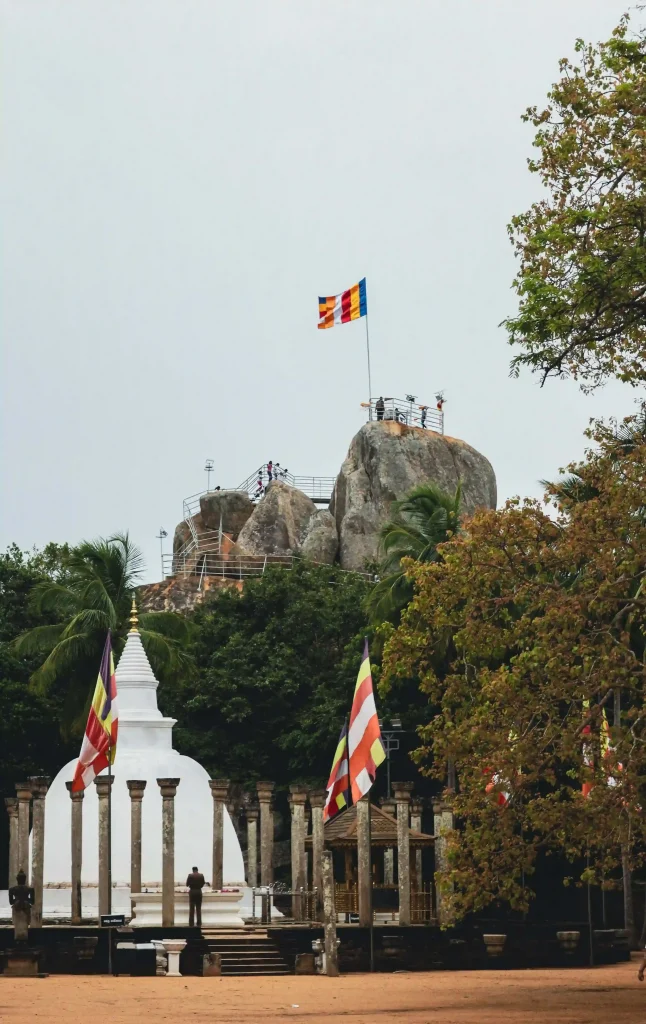
Ambasthala Dagoba stands on one of Mihintale’s principal upper terraces.
The location is traditionally associated with the historic meeting between Arahant Mahinda and King Devanampiyatissa.
The white stupa, surrounding rock formations and open views create one of the most recognisable religious settings on the hill.
Unlike the lower archaeological ruins, the upper terrace remains an active place of Buddhist devotion.
Worshippers visit to pay respect, make offerings and reflect on the importance of Mahinda’s arrival in Sri Lanka.
Approach the terrace quietly and remember that religious activity takes priority over sightseeing.
Why Ambasthala Is Important
Ambasthala is especially significant because of its connection with the beginnings of Buddhism in Sri Lankan historical tradition.
The location symbolises the meeting between royal authority and Buddhist teachings.
As Buddhism received royal support, religious institutions expanded across Anuradhapura and became an important part of the island’s cultural development.
The sacred terrace commemorates a defining moment in Sri Lanka’s Buddhist history.
It commemorates a moment regarded as central to Sri Lanka’s Buddhist identity.
Aradhana Gala: Mihintale’s Famous Rock Viewpoint
Aradhana Gala is one of Mihintale’s most dramatic natural landmarks.
The exposed rock rises above the upper sacred terrace and provides panoramic views of the surrounding forests, reservoirs and plains.
Its name is commonly translated as the Rock of Invitation, reflecting its association with Buddhist religious tradition.
The final ascent involves steep steps and sections where handrails assist visitors moving across the rock.
The elevated setting makes it particularly attractive for landscape photography, but reaching the top requires care.
Unlike the main stairway, Aradhana Gala involves more exposed surfaces and can feel uncomfortable for travellers who dislike heights.
Is Climbing Aradhana Gala Necessary?
No. The climb to Aradhana Gala is entirely optional.
Mihintale’s religious and historical importance can be appreciated without reaching the highest exposed viewpoint.
Travellers with limited mobility, balance difficulties or concerns about heights should not feel pressured to complete the final climb.
Wet rock can become particularly slippery, making the exposed ascent unsuitable during poor weather.
If you decide to climb, keep your hands free, use the available handrails and avoid taking photographs while moving.
The viewpoint is rewarding, but safety should always take priority.
Views from the Upper Hill
The upper sections of Mihintale offer wide views across the North Central Province.
From elevated terraces, visitors can appreciate the forests, reservoirs and open plains surrounding Anuradhapura.
The landscape also helps explain why the ancient settlement developed such an extensive network of water-management systems.
Reservoirs and other water features formed an important part of life in the dry-zone region.
The views are especially attractive in softer morning or late-afternoon light, when the surrounding landscape appears less harsh than under the midday sun.
Maha Seya: The Great Stupa
Maha Seya is one of the principal white stupas standing on Mihintale’s elevated sacred landscape.
Its large dome rises above the surrounding rock and vegetation, making it an impressive religious monument.
The stupa remains an important focus of Buddhist devotion and forms part of the wider pilgrimage complex.
Its position provides an opportunity to appreciate both sacred architecture and the dramatic natural setting of Mihintale.
Move respectfully around the terrace and follow the established direction used by worshippers when walking around the stupa.
Do not climb onto sacred structures or treat the monument as a platform for photography.
Mahinda’s Cave
Mahinda’s Cave is a natural rock shelter traditionally associated with Arahant Mahinda.
The location is connected with accounts of his residence and meditation at Mihintale.
Unlike the formal architecture of the stupas, the cave provides a reminder of the importance of natural rock shelters in early Buddhist monastic life.
Such shelters offered quiet spaces for meditation and residence away from the busier parts of religious settlements.
Reaching the cave involves additional walking across the hillside, including steps and uneven areas.
Visitors should treat the location respectfully because of its continuing religious significance.
Why Mihintale Is More Than a Viewpoint
Many travellers first recognise Mihintale through photographs of Aradhana Gala and the surrounding landscape.
However, the viewpoint represents only one part of the site.
The wider complex contains archaeological evidence of monasteries, water facilities, religious monuments and structures supporting a substantial Buddhist community.
Its importance comes from the combination of pilgrimage traditions, ancient architecture and the organisation of monastic life.
Understanding these features transforms Mihintale from a scenic hill climb into one of Sri Lanka’s most meaningful cultural experiences.
The Importance of Poson Poya
Poson Poya is one of the most important observances in Sri Lankan Buddhism.
Celebrated around June each year, it commemorates the introduction of Buddhism to Sri Lanka through the arrival of Arahant Mahinda.
Because of Mihintale’s association with Mahinda and King Devanampiyatissa, the sacred hill becomes a major centre of religious activity during Poson.
Large numbers of pilgrims visit to worship, make offerings and participate in religious observances.
The atmosphere can be particularly memorable, with devotional activity continuing across the sacred complex.
What to Expect During Poson
Poson brings substantially larger crowds to Mihintale and the wider Anuradhapura area.
Many devotees wear white clothing, and the stairway can become crowded as pilgrims ascend towards the sacred terraces.
Religious activities, decorations and community food offerings form part of the festival atmosphere.
Visitors should allow extra time for road travel, walking, queues and movement through the temple areas.
Public transport, parking and accommodation can also become busier during the festival period.
The festival follows the Buddhist lunar calendar, so its date changes each year.
Best Time of Day to Visit Mihintale
Early morning is generally the most comfortable time to explore Mihintale.
The temperature is lower, the stone steps are more manageable and the surrounding landscape can be particularly attractive in the softer light.
Late afternoon also offers beautiful conditions, especially around the elevated terraces and viewpoints.
However, allow sufficient daylight to descend the stairways safely.
The exposed rock areas are less suitable for climbing when visibility is poor or surfaces are wet.
For most travellers, avoiding the strongest midday heat makes the entire experience considerably more enjoyable.
Temple Dress Code at Mihintale
Mihintale remains an active Buddhist pilgrimage site, so modest clothing is required within its sacred areas.
Cover your shoulders and knees and avoid clothing that is excessively revealing or inappropriate in a religious setting.
Lightweight trousers, long skirts and breathable tops are practical choices in the dry-zone heat.
Footwear must be removed in designated sacred precincts, while hats should also be removed where instructed.
Follow directions from monks, temple attendants and site officers.
White clothing is commonly worn by Sri Lankan Buddhist pilgrims, although international visitors are not required to wear white.
Removing Shoes in Sacred Areas
Some parts of Mihintale require visitors to remove their shoes before entering religious precincts.
Stone surfaces can become extremely hot during the middle of the day.
Socks can make barefoot walking more comfortable where they are permitted by local religious rules.
Keep your footwear together and use designated storage areas where provided.
Remember that temple instructions take priority over ordinary hiking practices once you enter a sacred space.
Photography at Mihintale
Mihintale offers excellent opportunities for architectural, cultural and landscape photography.
The white stupas, ancient stone stairway, forested slopes and elevated viewpoints create varied photographic subjects.
Morning and late-afternoon light are especially attractive for capturing the surrounding landscape.
However, photography should never interfere with worship or visitor safety.
Ask permission before taking close photographs of identifiable pilgrims and avoid photographing people during private religious moments.
Do not attempt photographs while moving along steep or exposed sections of Aradhana Gala.
What to Wear and Bring for the Climb
Choose comfortable shoes with reliable grip that can be removed easily in sacred areas.
Wear breathable clothing that satisfies Buddhist temple dress requirements.
Carry enough drinking water, sun protection and a lightweight rain layer during unsettled weather.
A small daypack is more convenient than carrying unnecessary luggage up the stairway.
Keep both hands available when climbing steeper rock sections, particularly around Aradhana Gala.
Rain and Slippery Rock Surfaces
Rain can make Mihintale’s stone steps and exposed rock surfaces slippery.
The risk is particularly important around steeper sections of the upper hill.
Walk carefully on wet surfaces and avoid rushing downhill.
Aradhana Gala should not be attempted when the rock is slippery or conditions make the exposed climb uncomfortable.
During thunderstorms, avoid remaining on exposed elevated rocks and move towards a safer sheltered area.
Visiting Mihintale with Children
Families can enjoy Mihintale, particularly children who are interested in history, religious traditions and outdoor exploration.
However, the long stairway and exposed upper sections require supervision.
Children should remain close to an adult around steep steps, rock edges and crowded pilgrimage areas.
Take regular breaks and carry enough drinking water, especially in hot weather.
Explain beforehand that the sacred terraces are active religious places where quiet and respectful behaviour is expected.
The steepest rock viewpoint is not essential for younger children to appreciate the site.
Older Visitors and Accessibility
The number of steps makes Mihintale physically challenging for visitors with significant mobility limitations.
Some visitors may be comfortable exploring the lower archaeological areas without completing the full ascent.
Vehicle access towards higher sections may be available under local arrangements, but the sacred terraces and individual monuments still involve walking and changes in level.
Aradhana Gala is unsuitable for travellers who cannot manage steep exposed rock safely.
The site’s religious and historical importance can still be appreciated without reaching every elevated location.
How Long Should You Spend at Mihintale?
Allow approximately three to four hours for a comfortable visit.
This provides time for the principal stairway, upper sacred terraces, major stupas and panoramic views.
Travellers particularly interested in archaeology may want additional time for the lower monastic remains, ponds and other historical structures.
The climb can take longer during hot weather or crowded religious periods.
A relaxed pace makes it easier to appreciate the architecture, landscape and religious significance rather than concentrating only on reaching the highest point.
Getting to Mihintale from Anuradhapura
Mihintale lies approximately 12–15 kilometres east of Anuradhapura, depending on your starting location.
For most international travellers, a tuk-tuk, hired car or private driver is the simplest transport option.
Local buses also serve the Mihintale area, offering a lower-cost alternative for travellers comfortable using public transport.
A private vehicle is particularly convenient for arriving early or returning after a late-afternoon visit.
Agree the tuk-tuk or driver cost before travelling.
If arranging a return journey, confirm the pickup location and waiting arrangements before beginning the climb.
Entrance Tickets and Visitor Access
Mihintale includes active Buddhist religious spaces and protected archaeological areas.
Visitor access is managed according to the requirements of the relevant religious and heritage authorities.
Follow the entrance instructions for the sections you visit, including any ticket arrangements for archaeological areas or museum facilities.
Respect temporary restrictions during religious ceremonies, major festivals and conservation work.
Mihintale has separate visitor access arrangements, so follow the ticket instructions for individual archaeological areas and facilities.
Respecting Mihintale’s Sacred Heritage
Mihintale remains a functioning Buddhist religious landscape.
Keep voices low in sacred areas and give worshippers priority during prayers and offerings.
Do not climb onto stupas, touch protected sculptures or remove stones from archaeological remains.
Stay on designated routes and avoid damaging vegetation around the ancient monastic structures.
Carry rubbish away rather than leaving bottles or food packaging on the hillside.
Respectful behaviour helps preserve both the physical heritage and the religious atmosphere that makes Mihintale important.
Is Mihintale Worth Visiting?
Yes. Mihintale is one of the most significant places in Sri Lanka for understanding the island’s Buddhist history and living pilgrimage traditions.
The ancient stairway, Ambasthala Dagoba, Maha Seya, Aradhana Gala and surrounding monastic remains create a cultural landscape that is both historically important and visually memorable.
The experience also reveals how ancient Buddhist communities organised religious life within a complex natural environment.
For travellers interested in archaeology, architecture and religion, Mihintale offers considerably more than a scenic climb.
It is a sacred hill where Sri Lankan Buddhist tradition, ancient history and modern pilgrimage continue to meet.