Coconut Tree Hill is one of Mirissa’s most recognisable coastal viewpoints, famous for its tall coconut palms, reddish earth and beautiful views across the Indian Ocean. Located on a small headland at the eastern end of the Mirissa beach area, this scenic spot offers an opportunity to enjoy Sri Lanka’s southern coastline from a different perspective.
Unlike a major hiking destination or a developed tourist attraction, Coconut Tree Hill is a simple natural viewpoint. The experience centres on the palm-covered landscape, sea breeze, changing coastal light and photographs of the surrounding ocean.
This complete visitor guide explains how to reach Coconut Tree Hill, when to visit, what to expect from the walk, where to take photographs, how to avoid the busiest periods and the safety precautions worth understanding before arriving.
Location: Eastern side of Mirissa, Southern Province
Best for: Coastal views, photography, sunrise and late-afternoon light
Time needed: Approximately 45–90 minutes, including the approach
Walking difficulty: Easy to moderate, depending on ground conditions
Best time: Early morning for fewer crowds
Access: Short walk from the Mirissa beach area or a local road approach
Footwear: Sandals or shoes with reliable grip
Important: Exposed cliff edges, uneven ground and slippery surfaces after rain
Palm-framed views above the Indian Ocean
Discover Coconut Tree Hill in Mirissa
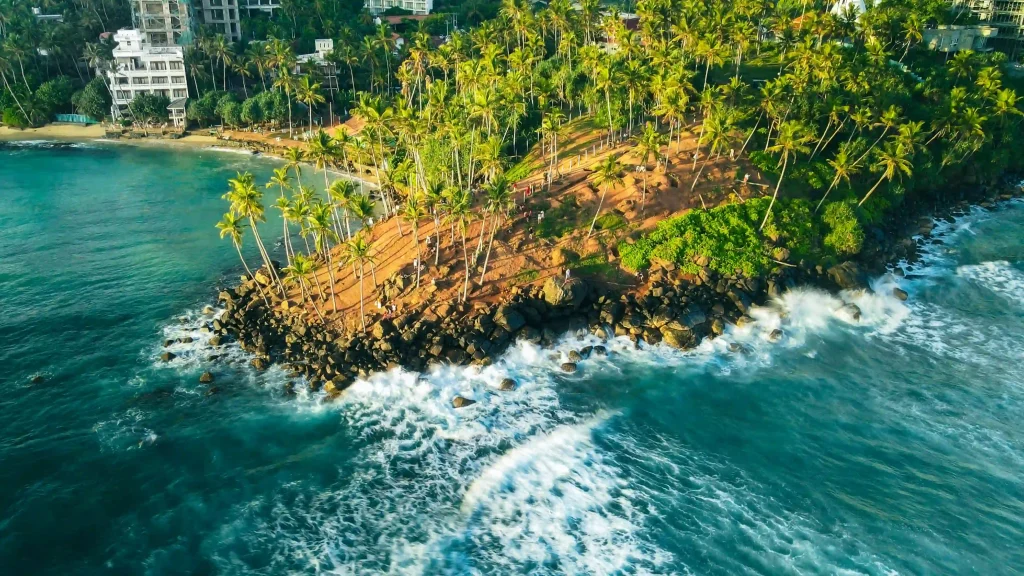
Coconut Tree Hill is a small coastal headland covered with tall coconut palms, overlooking the ocean near Mirissa’s popular beach area.
It has become one of the most photographed locations on Sri Lanka’s southern coast, thanks to its distinctive combination of palm trees, open sky and uninterrupted sea views.
The landscape is simple but striking. Coconut palms rise from reddish-brown earth, while the surrounding shoreline curves towards neighbouring rocky sections and sandy beaches.
The viewpoint is particularly attractive in the softer light of early morning and late afternoon, when the colours of the palms, ground and ocean become more noticeable.
There are no grand monuments, elaborate gardens or extensive walking trails. The attraction is the natural coastal setting itself.
For international travellers staying in Mirissa, Coconut Tree Hill offers an enjoyable opportunity to appreciate the coastline away from the main activity of the beach.
Why Coconut Tree Hill Is Famous
Coconut Tree Hill has become an instantly recognisable image of Mirissa, appearing in travel photographs and social media posts featuring Sri Lanka’s tropical coastline.
Its appeal comes from the unusual arrangement of tall palm trees standing together on an open headland above the sea.
The reddish ground, green palm leaves and blue ocean create a natural colour contrast that makes the viewpoint particularly photogenic.
Unlike viewpoints where buildings or railings dominate the foreground, Coconut Tree Hill retains a relatively natural appearance.
However, its popularity also means that it can become busy, especially when visitors arrive to photograph the same recognisable palm-lined landscape.
Approaching the experience with realistic expectations makes it more enjoyable. Coconut Tree Hill is a popular coastal viewpoint, not a remote or undiscovered location.
What Does Coconut Tree Hill Look Like?
The viewpoint consists of a relatively small, elevated area covered with coconut palms and patches of exposed reddish soil.
From the open sections, visitors can look out across the Indian Ocean and back towards parts of the Mirissa coastline.
The palms provide attractive framing for photographs, while the surrounding headland creates a sense of height above the water.
The ground is natural rather than fully landscaped. Some sections contain worn paths, exposed roots, small slopes and uneven surfaces.
There is no continuous protective barrier around the entire viewpoint, so visitors must remain aware of the exposed edges.
Wind is also an important feature of the setting, often moving the coconut leaves and creating the relaxed coastal atmosphere for which the viewpoint is known.
Where Is Coconut Tree Hill Located?
Coconut Tree Hill is situated on the eastern side of the Mirissa beach area in Sri Lanka’s Southern Province.
It lies within convenient reach of the town’s main accommodation, restaurants and beach facilities.
Travellers staying near the eastern end of Mirissa may be able to reach the area on foot, depending on the location of their accommodation and the available public paths.
Those staying farther away can use a tuk-tuk or taxi to reach a suitable access point before walking the final section.
The viewpoint is closely associated with Mirissa Beach, but the last part of the approach involves reaching an elevated headland rather than remaining on level sand.
How to Get to Coconut Tree Hill
Coconut Tree Hill is accessible by a short walk from nearby parts of Mirissa or by using a local road approach followed by a short uphill walk.
There are two general ways visitors reach the area: along the coastline when sea conditions allow, or via established inland access paths from nearby roads.
The most suitable approach depends on where you are staying, the tide, recent rainfall and local access arrangements.
Some coastal paths pass near accommodation and privately maintained properties. Always follow established public access rather than crossing private gardens or hotel grounds without permission.
If travelling by tuk-tuk, ask to be dropped near the recognised public approach to Coconut Tree Hill.
Agree the tuk-tuk or driver fare before travelling.
Walking from Mirissa Beach
Visitors staying near Mirissa Beach can often reach Coconut Tree Hill without arranging a long vehicle journey.
The coastline offers an attractive setting for a short walk, with views of the ocean and neighbouring headlands along the way.
However, beach-level access is influenced by the tide and the condition of the sea.
During periods of stronger swell, some rocky or narrow shoreline sections can become difficult or unsafe to cross.
A public road approach is a more sensible alternative when the coastal route is affected by waves or high water.
Do not attempt to pass through breaking surf or climb over slippery shoreline rocks simply to shorten the journey.
Using the Road Approach
An inland road approach can be more comfortable than walking along the shoreline, particularly when the sea is rough.
Visitors generally reach the wider Coconut Tree Hill area through local streets before continuing along an established path towards the headland.
The final approach still involves natural ground and a small uphill section.
Access routes may pass close to accommodation and privately used land, so respect gates, signs and property boundaries.
For international travellers unfamiliar with the area, a locally arranged tuk-tuk can simplify the journey to the correct public approach.
A short road transfer may be particularly convenient during hot weather or when carrying photography equipment.
How Difficult Is the Walk?
The walk to Coconut Tree Hill is relatively short and does not require technical hiking experience.
Most visitors with ordinary mobility can manage the approach comfortably in dry weather.
However, the final section is not a fully paved, level walking path.
Uneven soil, exposed roots and worn surfaces can require additional attention, especially after rain.
Some visitors may also find the elevated headland uncomfortable because of its open cliff edges.
The main challenge is therefore not the walking distance but the condition of the ground and the need to move carefully near exposed areas.
What Shoes Should You Wear?
Comfortable sandals or shoes with reliable grip are recommended for visiting Coconut Tree Hill.
On a dry day, the approach is generally straightforward, but wet soil and exposed roots can become unexpectedly slippery.
Smooth flip-flops provide less stability on uneven ground and are particularly unsuitable after rainfall.
Walking barefoot may feel comfortable on dry grass, but it offers limited protection against rough surfaces, sharp objects and hot ground.
Choose footwear that allows you to move confidently without worrying about slipping on the final approach.
Best Time of Day to Visit Coconut Tree Hill
Early morning is generally the best time to visit Coconut Tree Hill.
Temperatures are usually more comfortable, the light is softer and fewer people may be gathered around the most popular photography positions.
The quieter atmosphere makes it easier to enjoy the scenery without constantly waiting for other visitors to move.
Late afternoon is another attractive period, particularly for travellers who enjoy warmer light and the lively atmosphere of Mirissa’s coastline.
However, the approach to sunset can attract larger crowds.
Midday is generally less comfortable because of the heat, stronger sunlight and limited shade across the exposed headland.
Is Coconut Tree Hill Better at Sunrise or Sunset?
Both sunrise and sunset periods can be beautiful at Coconut Tree Hill, but they create different experiences.
Early morning is particularly rewarding for visitors who prefer cooler temperatures, quieter surroundings and more freedom to explore different photographic angles.
Late afternoon can produce warm light across the palms and coastline, creating a more social atmosphere as visitors arrive from nearby beaches.
The appearance of the sky and the position of the sun change with the season and weather.
The sun will not necessarily rise or set directly in front of the viewpoint on every date.
The broad coastal panorama remains the main attraction, regardless of the precise position of the sunrise or sunset.
Why Early Morning Is Good for Photography
Early morning is an excellent period for photographing Coconut Tree Hill because the softer light helps reveal detail in the palms and surrounding landscape.
Shadows can create additional depth, while the ocean often takes on attractive colours as the day begins.
There may also be fewer visitors standing in the most popular areas, making it easier to compose photographs without extensive waiting.
The morning atmosphere can be particularly pleasant for travellers who enjoy taking photographs slowly rather than competing for a particular viewpoint.
For most visitors prioritising photography, arriving early offers the best combination of light, comfort and space.
What to Expect at Sunset
Late afternoon is one of the busiest periods at Coconut Tree Hill, especially during Mirissa’s popular tourist season.
The palms can look particularly attractive in the warmer light, and the coastal scenery becomes more atmospheric as the sun moves lower.
However, the small headland can fill with people waiting for photographs.
The most popular angles may have several visitors using the same space.
Rather than expecting an empty viewpoint, allow time to appreciate the atmosphere and use alternative photographic compositions.
Keep the return walk in mind as daylight fades, particularly if the ground is uneven or the route is unfamiliar.
Best Season to Visit Coconut Tree Hill
Coconut Tree Hill can be visited throughout the year, but weather and sea conditions influence the experience.
Mirissa’s generally drier south-coast period falls between approximately November and April, when conditions are often favourable for enjoying the beach and nearby coastal attractions.
During wetter months, rainfall can make the headland greener, but the ground may also become muddy and slippery.
Rough seas can affect shoreline approaches, making an established road path preferable.
Regardless of the month, early morning usually provides a more comfortable opportunity to enjoy the exposed viewpoint.
Cliff-Edge Safety at Coconut Tree Hill
Coconut Tree Hill is a natural coastal headland with exposed drops towards the sea.
Stay well back from the cliff edges at all times.
The ground near an exposed edge may be uneven, weathered or unstable, particularly following heavy rainfall.
Do not sit on overhanging soil, climb onto unstable rocks or jump between exposed sections.
When taking photographs, look carefully at the ground before moving and never step backwards towards the edge while concentrating on your phone screen.
Wind, crowds and limited space can increase the risk of losing balance.
A photograph taken from a stable position inside the headland is far more important than reaching an exposed edge for a dramatic image.
Visiting Coconut Tree Hill After Rain
Rain can significantly change the walking conditions around Coconut Tree Hill.
The reddish soil may become muddy, while exposed roots and worn footpaths can be slippery.
Wet conditions also make it more important to avoid the cliff edges.
Walk slowly, wear suitable footwear and allow others sufficient space on narrow sections.
After heavy rain, avoid taking shortcuts across steep or eroded ground.
If thunderstorms are approaching, leave the exposed headland and seek appropriate shelter. Tall palms and open coastal ground are not suitable places to remain during lightning.
Staying Safe Around the Coconut Palms
The tall coconut palms are the defining feature of the viewpoint, but they are also living trees within a coastal environment.
Avoid climbing palms, pulling leaves or interfering with the surrounding vegetation.
Be mindful of the possibility of falling coconuts and branches, especially during windy conditions.
Do not remain directly beneath trees unnecessarily when strong gusts are moving through the area.
Take photographs from a comfortable distance and allow the trees to form part of the landscape naturally.
Photography Tips for Coconut Tree Hill
Coconut Tree Hill provides excellent opportunities for landscape photography, particularly when combining the palms with the surrounding ocean.
Rather than trying to include every tree in one photograph, use selected palms to frame the coastline or open sky.
A wide-angle lens can capture the overall landscape, while a longer focal length can highlight individual trees, waves, boats or distant coastal features.
Pay attention to the horizon and use the contrast between the reddish soil, green palms and blue water to create balanced compositions.
Wind frequently moves the palm leaves, so a faster shutter speed is useful when photographing foliage.
Keep equipment manageable because large tripods and heavy bags can be inconvenient on a crowded, uneven headland.
Taking Photos with a Smartphone
You do not need a professional camera to capture attractive photographs at Coconut Tree Hill.
Modern smartphones work particularly well for wide coastal scenes, palm-tree silhouettes and landscape compositions.
Use the main camera for natural-looking detail or a wider setting when you want to include more of the surrounding trees.
Try photographing from slightly different positions within safe areas rather than relying on one popular viewpoint.
Early morning and late-afternoon light can help create softer colours without extensive editing.
Keep your phone secure when moving over uneven ground, and do not walk backwards while looking at the screen.
How to Avoid Photography Crowds
Coconut Tree Hill’s popularity means the viewpoint is often shared by people hoping to capture similar photographs.
Early morning generally provides the best opportunity for quieter conditions.
At busier times, patience and flexibility make the experience much more enjoyable.
Take a few photographs from a suitable position, then allow others to use the same space.
Consider wider compositions that include the atmosphere of the viewpoint rather than waiting for every person to disappear.
Different perspectives from safe areas of the headland can create photographs that are just as attractive as the familiar social media image.
Respecting Other Visitors
The open area at Coconut Tree Hill is relatively small, so considerate behaviour is especially important.
Avoid occupying the same popular photography position for an extended personal photoshoot when other visitors are waiting.
Do not ask strangers to leave public viewing areas simply because they appear in your photograph.
Keep tripods, bags and other equipment away from narrow paths and places where people are walking.
Be careful when moving around visitors who may be concentrating on cameras rather than the surrounding ground.
Respectful behaviour helps maintain the relaxed coastal atmosphere that makes the viewpoint enjoyable.
Drone Photography at Coconut Tree Hill
Drone operations in Sri Lanka are regulated by the Civil Aviation Authority of Sri Lanka.
Visitors intending to fly a drone must follow the applicable aviation requirements and check whether the chosen location falls within a restricted or authorisation-controlled area.
Local property rights and privacy must also be respected.
Coconut Tree Hill is often crowded and has limited open space, making it an unsuitable location for careless launching or landing.
Drone use should only take place with the necessary authorisation and appropriate safety arrangements.
Official drone information: Civil Aviation Authority of Sri Lanka.
Coconut Tree Hill and Mirissa Beach
One of Coconut Tree Hill’s greatest advantages is its proximity to Mirissa Beach.
The main beach is known for its broad sandy bay, restaurants and relaxed south-coast atmosphere.
Coconut Tree Hill offers a different perspective, replacing the beach-level view with an elevated panorama across the coastline.
The two locations therefore provide complementary experiences without requiring a long journey between them.
Visitors should remember that sea conditions suitable for enjoying the beach are not necessarily the same as those required for safely using a rocky coastal access path.
Always assess the water conditions separately from the weather on the headland.
Coconut Tree Hill or Parrot Rock?
Coconut Tree Hill and Parrot Rock are two of Mirissa’s best-known coastal viewpoints, but they offer different experiences.
Coconut Tree Hill is the better choice for a palm-covered headland, open ocean views and the distinctive landscape that has become associated with Mirissa.
Parrot Rock provides a closer view across the main Mirissa bay from a smaller rocky formation near the beach.
Parrot Rock is more directly influenced by the tide and wave conditions because of its beach-level access.
The route to Parrot Rock may become dangerous when the sea is rough or water levels are high.
For travellers choosing only one viewpoint, Coconut Tree Hill is generally the more straightforward option for appreciating the area’s famous palm-framed coastal scenery.
Is Coconut Tree Hill a Swimming Spot?
Coconut Tree Hill is primarily a scenic viewpoint, not a designated swimming beach.
The headland rises above rocky coastal surroundings, and the exposed edges should not be used to enter the sea.
Visitors should avoid climbing down unstable slopes or attempting to reach the water from the viewpoint.
Those interested in swimming should use an appropriate beach area where current sea and wave conditions are suitable.
Even around Mirissa Beach, swimming safety depends on the season, swell and local currents.
Never assume that calm-looking water beside rocks is safe for entering the sea.
How Long Should You Spend at Coconut Tree Hill?
For most visitors, approximately 45–90 minutes is sufficient, including the short approach and time to enjoy the views.
The viewpoint itself is relatively small, and there are no extensive facilities or additional attractions requiring several hours of exploration.
Photography enthusiasts may prefer additional time to experiment with different compositions and changing light.
However, spending longer does not necessarily improve the experience, especially during crowded periods or hot weather.
A relaxed visit that includes time to appreciate the scenery is more rewarding than waiting indefinitely for a completely empty viewpoint.
Visiting Coconut Tree Hill with Children
Coconut Tree Hill can be enjoyable for families, particularly children who like short outdoor walks and coastal scenery.
However, the viewpoint has exposed cliff edges and uneven natural ground.
Young children should remain close to an adult throughout the visit.
Do not allow children to run near the edges, climb coconut trees or play on exposed rocks.
Suitable footwear and supervision are especially important after rainfall.
Families should choose safe positions within the main headland rather than attempting to reach every popular photography spot.
Accessibility and Mobility Considerations
The approach to Coconut Tree Hill is relatively short, but the natural terrain can create difficulties for some visitors.
Uneven soil, worn paths, exposed roots and slippery surfaces may be challenging for people with reduced balance or limited mobility.
The viewpoint is not a purpose-built observation platform with continuous paved access and protective barriers.
Visitors using mobility aids may find the final approach difficult.
Anyone uncomfortable with the terrain should prioritise safety and enjoy the coastline from a more accessible position.
Reaching the most exposed section is not necessary to appreciate Mirissa’s coastal scenery.
What Should You Bring?
Coconut Tree Hill is a short outdoor visit, so a small bag containing essentials is usually sufficient.
- Comfortable sandals or shoes with good grip.
- Drinking water.
- Sunscreen and sunglasses.
- A hat for sunny conditions.
- A camera or charged smartphone.
- A lightweight waterproof layer if needed.
- A small bag for carrying rubbish away.
Keep belongings light and leave unnecessary equipment at your accommodation.
Moving safely over the natural ground is easier when your hands are free and you are not carrying an oversized camera bag.
Responsible Visiting at Coconut Tree Hill
Coconut Tree Hill is a natural coastal area, and its appeal depends on preserving the landscape that attracts visitors.
Stay on established ground rather than damaging vegetation or creating new tracks across fragile soil.
Do not carve names into coconut palms, remove plants or tie decorations to trees for photographs.
Carry all rubbish away and avoid leaving food packaging among the roots or along the cliff edges.
Respect nearby accommodation, private property and local residents.
A popular viewpoint is still part of a living coastal community, and responsible tourism should protect both its natural environment and the people who live nearby.
Is Coconut Tree Hill Worth Visiting?
Yes. Coconut Tree Hill is one of Mirissa’s most attractive coastal viewpoints and a worthwhile experience for visitors staying in the area.
The short walk, recognisable coconut palms and expansive Indian Ocean views make it particularly appealing for photography and relaxed sightseeing.
Its simplicity is part of its charm. There is no major monument to explore or lengthy hiking trail to complete.
The best experience comes from visiting at a comfortable time, appreciating the natural scenery and moving carefully around the exposed headland.
Early morning is especially rewarding for quieter conditions, while late afternoon offers beautiful light for those comfortable with a livelier atmosphere.
For international travellers exploring Sri Lanka’s southern coast, Coconut Tree Hill provides one of Mirissa’s most memorable views.