Discover Victoria Park, one of Nuwara Eliya’s most beautiful public gardens and a peaceful green space in the heart of Sri Lanka’s hill country. Known for its colourful flower beds, mature trees, scenic walking paths and remarkable birdlife, the park offers a relaxing escape from the surrounding town. This guide covers its history, seasonal flowers, birdwatching, walking conditions and practical advice for international visitors.
Location: Central Nuwara Eliya, Central Province
Size: Approximately 27 acres (11 hectares)
Best for: Gardens, birdwatching, photography, gentle walking and families
Time needed: Around 1–2 hours
Best time of day: Early morning or late afternoon
Flowering highlights: March and April
Getting there: Easily accessible from central Nuwara Eliya
Quiet gardens beneath Nuwara Eliya skies
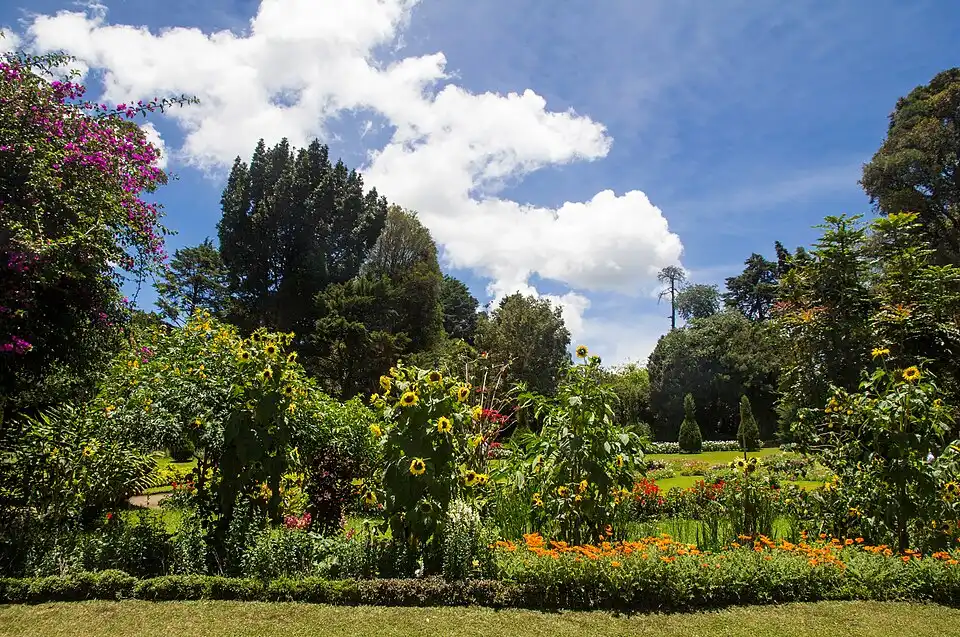
Photo: Alexey Komarov / Wikimedia Commons / CC BY 3.0
Discover Victoria Park in Nuwara Eliya
Victoria Park is one of the most attractive green spaces in Nuwara Eliya, offering landscaped gardens, mature trees and peaceful walking paths close to the town centre.
Covering approximately 27 acres, the park provides a pleasant contrast to the surrounding streets, shops and colonial-era buildings.
Its carefully maintained lawns, colourful flower beds and shaded pathways make it a favourite recreational area for residents and visitors.
Unlike many of Nuwara Eliya’s natural attractions, Victoria Park does not require a long journey into the surrounding hills.
Its central location makes it particularly convenient for international travellers who want to enjoy the cool highland atmosphere without arranging additional transport.
Victoria Park is also recognised for its birdlife, attracting both casual nature enthusiasts and more experienced birdwatchers interested in Sri Lanka’s highland species.
Why Victoria Park Is Worth Visiting
Nuwara Eliya is famous for tea plantations, mist-covered hills and cool mountain scenery, but Victoria Park offers a different way to experience the town’s natural environment.
The park combines formal ornamental gardens with mature vegetation and quieter habitats that support birds and other small wildlife.
Visitors can enjoy an easy walk, admire seasonal flowers or spend time observing birds among the trees and waterways.
The atmosphere is generally more relaxed than at the town’s busier commercial areas.
For families, it provides open space away from traffic, while photographers can enjoy the colourful gardens and distinctive highland setting.
Its greatest appeal is simplicity: a peaceful garden experience that can be enjoyed without specialised equipment or demanding physical activity.
The History of Victoria Park
Victoria Park’s origins date to the late nineteenth century, during the period when Nuwara Eliya was developing as a highland retreat under British colonial administration.
The grounds were originally connected with botanical research associated with Hakgala Botanical Gardens, another important horticultural institution in the region.
The park’s early development is traditionally linked with the planting of an oak tree by a visiting member of German royalty.
Over time, the grounds developed into an ornamental public garden with lawns, trees, flower beds and recreational spaces.
In 1897, the park was named Victoria Park to commemorate Queen Victoria’s Diamond Jubilee, marking sixty years of her reign.
Today, Victoria Park continues to serve as a public recreational space while preserving elements of Nuwara Eliya’s colonial-era landscape design.
Victoria Park and Queen Victoria’s Diamond Jubilee
The name Victoria Park reflects an important period in the development of Nuwara Eliya.
During British rule, the town became known for its cooler climate, gardens and architecture influenced by European styles.
Its highland conditions made it a popular retreat from the hotter lowland regions.
Queen Victoria’s Diamond Jubilee in 1897 was commemorated throughout different parts of the British Empire.
The naming of Victoria Park formed part of this historical context.
Although the park retains its historical name, it functions today as a popular Sri Lankan public garden enjoyed by families, local residents and international travellers.
From Botanical Research to Public Gardens
Before becoming a public ornamental park, the grounds were associated with botanical work connected to Hakgala Botanical Gardens.
Nuwara Eliya’s cool highland climate made the region particularly suitable for cultivating and studying plants that thrive in temperate conditions.
This horticultural history helps explain the park’s mature trees, ornamental planting and carefully arranged landscape.
Its vegetation includes numerous introduced plant species alongside the greenery characteristic of Sri Lanka’s central highlands.
Today, the park is maintained as a recreational garden rather than a formal botanical research centre.
Nevertheless, its trees, flower beds and landscaped spaces continue to reflect the horticultural traditions associated with Nuwara Eliya.
What Does Victoria Park Look Like?
Victoria Park is a combination of open lawns, flowering gardens, mature trees, pathways and small waterways.
Some areas are spacious and open, while others feel more enclosed because of the surrounding vegetation.
Walking paths connect different parts of the grounds, allowing visitors to enjoy the gardens at a comfortable pace.
The mature trees provide shade and create attractive views across the lawns.
Flower beds add seasonal colour, while quieter sections near vegetation and water provide opportunities for birdwatching.
Although the park is located within the town, its landscaped surroundings create a noticeably calmer atmosphere than the nearby roads.
The Beautiful Flower Gardens
Victoria Park is particularly well known for its seasonal flower displays.
Carefully arranged flower beds create colourful patterns across the grounds, making the park an attractive destination for garden enthusiasts and photographers.
Nuwara Eliya’s cool climate supports a variety of ornamental plants, including flowers commonly associated with temperate gardens.
The appearance of the displays changes throughout the year as different plants flower and the grounds are maintained.
During the most colourful periods, bright flowers contrast beautifully with the surrounding green lawns and mature trees.
Even outside the principal flowering season, the park’s established vegetation provides an attractive setting for a peaceful walk.
When Are the Flowers Best?
March and April are particularly rewarding months for appreciating Victoria Park’s colourful flower gardens.
During this period, the park is known for its vibrant seasonal displays.
April is also an important holiday period in Nuwara Eliya, when the town attracts large numbers of domestic visitors.
As a result, the gardens can become noticeably busier, particularly during weekends and public holidays.
Travellers interested in photographing flowers without large crowds may prefer visiting earlier in the morning.
Other months offer different combinations of greenery and flowers, with the mature garden landscape remaining attractive throughout the year.
Mature Trees and Shaded Walkways
One of Victoria Park’s greatest features is its collection of mature trees.
These trees provide shade, contribute to the garden’s established appearance and create habitat for resident and visiting birds.
Their branches and foliage also add depth to the park’s scenery, making the garden feel different from a simple open lawn.
Walking beneath the trees can be especially pleasant when the sun is strong.
The variety of vegetation creates a changing visual experience as visitors move between open flower beds and more sheltered areas.
For travellers interested in nature photography, the tree-lined paths offer attractive compositions throughout the day.
Nanu Oya and the Park’s Waterways
The Nanu Oya watercourse passes through Victoria Park, contributing to the garden’s natural character.
Small waterways and water features create pleasant scenery among the lawns and vegetation.
These areas also contribute to the habitats used by birds and other small wildlife.
The combination of water, planted gardens and mature trees gives the park greater environmental variety than a simple ornamental lawn.
Visitors interested in birdwatching may find the vegetation around water particularly rewarding.
Remain on recognised paths and avoid disturbing the banks or entering water features.
Birdwatching at Victoria Park
Victoria Park is one of the easiest places in central Nuwara Eliya to enjoy birdwatching.
The mixture of mature trees, dense vegetation, lawns and waterways provides habitat for a variety of resident and migratory birds.
The park is particularly interesting because it attracts species associated with Sri Lanka’s cooler highland environment.
Birdwatchers may encounter birds feeding in the undergrowth, moving through tree branches or using the edges of the park’s water features.
Some species are relatively easy to notice, while others spend much of their time hidden among dense vegetation.
Walking quietly and observing carefully often produces a more rewarding experience than moving quickly through the grounds.
Indian Blue Robin
The Indian Blue Robin is one of the bird species associated with Victoria Park’s birdwatching reputation.
This attractive migratory bird can be challenging to observe because it frequently uses shaded undergrowth and dense vegetation.
Rather than remaining exposed on open lawns, it often moves through quieter areas near the ground.
Birdwatchers interested in this species should pay particular attention to sheltered vegetation and avoid unnecessary noise.
Binoculars can help identify birds without approaching them too closely.
Patience is particularly useful when observing species that prefer concealed habitats.
Kashmir Flycatcher
The Kashmir Flycatcher is another notable migratory species associated with Victoria Park.
This bird is of particular interest to visiting birdwatchers because Sri Lanka forms part of its non-breeding range.
The park’s trees and sheltered habitats provide opportunities for observing migratory birds during suitable seasonal periods.
Flycatchers can often be recognised by their behaviour as they search for insects among branches and vegetation.
Birdwatchers should observe from a respectful distance and avoid disturbing birds to obtain photographs.
The presence of migrant birds adds an important wildlife dimension to a park already valued for its ornamental gardens.
Other Birds Around Victoria Park
Victoria Park and the surrounding highland environment support a variety of other bird species.
Birds such as the Pied Thrush and Scaly Thrush can also be spotted among the park’s sheltered vegetation.
Other birds associated with Nuwara Eliya’s highland habitats include the Yellow-eared Bulbul and Sri Lanka White-eye.
Different species favour different feeding areas, from open branches to dense undergrowth.
Observing their movements and behaviour can make even a short visit interesting.
For beginners, the park provides an approachable setting for learning how to identify birds by their appearance, movement and calls.
Best Time for Birdwatching
Early morning is generally the most rewarding period for birdwatching in Victoria Park.
The grounds are often quieter, making it easier to hear bird calls and notice movement among the vegetation.
Morning light can also be helpful for observing and photographing birds before activity increases around the gardens.
Birdwatchers should concentrate on quieter paths, dense shrubs and vegetation near water rather than remaining only in open ornamental areas.
Binoculars are useful for observing birds without moving too close.
A quiet, patient approach helps protect the park’s wildlife while improving the quality of the experience.
Birdwatching Etiquette
Victoria Park is both a public garden and a valuable urban habitat for birds.
Visitors should avoid disturbing wildlife or damaging vegetation while looking for particular species.
Stay on recognised paths rather than entering dense shrubs or planted areas.
Do not use loud recorded bird calls to attract birds or encourage them to leave sheltered habitats.
Keep a respectful distance from feeding or resting birds.
If photographing wildlife, use binoculars or a suitable zoom lens instead of approaching the animal unnecessarily.
Responsible birdwatching helps preserve the peaceful environment that makes Victoria Park attractive to both birds and people.
Walking Around Victoria Park
Victoria Park is particularly suitable for visitors looking for an easy walk without the demands of a mountain trail.
Its established paths connect the principal garden areas, allowing travellers to explore at their own pace.
The setting is suitable for relaxed walking, enjoying the scenery and stopping occasionally to observe flowers or birds.
Unlike hiking destinations around Nuwara Eliya, the park does not require specialised trekking equipment.
Comfortable shoes are generally sufficient for the formal paths.
Allow extra care after rain, when some surfaces may become wet or slippery.
How Long Should You Spend?
For most international visitors, one to two hours is enough to enjoy Victoria Park comfortably.
A shorter visit allows time to appreciate the main flower gardens, shaded paths and general atmosphere.
Travellers interested in photography or birdwatching may prefer more time, particularly when observing birds in quieter vegetation.
The park is well suited to unhurried exploration rather than covering a fixed walking distance.
Its relatively compact size is part of the attraction, making it enjoyable without committing to a demanding outdoor excursion.
Photography at Victoria Park
Victoria Park offers numerous opportunities for garden and nature photography.
Colourful flower beds provide attractive subjects, particularly during March and April.
Mature trees, winding paths and water features create additional compositions throughout the grounds.
Early morning light is especially appealing for photography because it is often softer and the park may be quieter.
After light rain, the vegetation can appear particularly fresh, with water droplets adding detail to flowers and leaves.
Visitors should remain on paths and avoid stepping into planted beds or disturbing gardeners while taking photographs.
Victoria Park for Families with Children
Victoria Park is one of Nuwara Eliya’s most convenient attractions for families.
The open garden setting allows children to enjoy greenery and fresh air without the physical demands of a long hike.
The park also includes recreational space and a children’s play area, making it attractive to families with younger visitors.
Parents can enjoy the surrounding gardens while children appreciate the more relaxed environment.
Supervise children near waterways, planted flower beds and any uneven surfaces.
Encourage them to respect the gardens and avoid picking flowers or disturbing wildlife.
Accessibility and Visitor Comfort
Victoria Park’s formal walking paths are generally less demanding than Nuwara Eliya’s mountain trails and natural hiking routes.
However, individual surfaces, kerbs and entrances may present difficulties for visitors with reduced mobility.
Travellers who need easier access should use the main entrance and select the more level paths through the gardens.
The grounds offer opportunities for shorter walks without needing to explore every section.
Benches and shaded areas can provide welcome opportunities to rest.
Visitors using mobility aids should allow additional time, particularly after rain when some surfaces may be slippery.
Weather and What to Wear
Nuwara Eliya has a cooler climate than most of Sri Lanka’s coastal and lowland destinations.
Victoria Park is therefore usually comfortable for walking, although temperatures and weather can change during the day.
Mornings may feel cool, while sunshine can make exposed garden areas noticeably warmer.
Rain showers and mist are also part of the highland environment.
Wear comfortable walking shoes and carry a lightweight jacket or jumper, particularly during cooler mornings and evenings.
A compact umbrella or waterproof layer is useful when the weather is unsettled.
Visiting Victoria Park During Rain
Light rain can create an attractive atmosphere in Victoria Park, particularly when mist settles among the trees and flowers.
The gardens often appear fresh after a shower, with deeper green colours and wet foliage adding interest to photographs.
However, prolonged rain can make walking less comfortable.
Paths, benches and grassy areas may become wet, while sheltered spaces can be limited in some parts of the grounds.
Comfortable footwear with reasonable grip is useful during damp weather.
Keep cameras and other electronic equipment protected from moisture.
Getting to Victoria Park
Victoria Park is located in central Nuwara Eliya, making it one of the town’s easiest attractions to reach.
Travellers staying in centrally located accommodation can often walk to the park without arranging transport.
Those staying farther from the centre can use a tuk-tuk, taxi or private vehicle.
The park’s location close to shops and other town facilities makes it convenient for visitors exploring Nuwara Eliya independently.
Agree the tuk-tuk or driver cost before travelling.
For visitors unfamiliar with the town, the central location makes the park relatively straightforward to find.
Entrance Tickets and Park Access
Victoria Park is a maintained public garden managed by the Nuwara Eliya Municipal Council.
Foreign visitors pay an entrance fee, with tickets purchased through the park’s visitor arrangements.
Carry some Sri Lankan rupee cash for admission and other small expenses.
Use the recognised entrance and follow any park rules displayed by the management.
Stay within public visitor areas and respect restrictions around landscaped beds, maintenance work and protected vegetation.
Victoria Park Compared with Hakgala Botanical Gardens
Victoria Park and Hakgala Botanical Gardens are both known for their plants and landscaped surroundings, but they offer different experiences.
Victoria Park is a compact public garden in central Nuwara Eliya, particularly suitable for easy walking, casual birdwatching and enjoying seasonal flowers.
Hakgala Botanical Gardens is a larger botanical attraction outside the town centre, with a greater emphasis on extensive plant collections and landscaped garden areas.
Victoria Park is the more convenient option for travellers who want a relaxed garden visit without arranging a longer journey.
Hakgala appeals particularly to visitors with a strong interest in horticulture and larger botanical landscapes.
Responsible Visiting at Victoria Park
Victoria Park’s appearance depends on the care given to its plants, lawns and wildlife habitats.
Visitors can help protect the grounds by remaining on recognised paths and avoiding damage to flower beds.
Do not pick flowers, remove plants or interfere with maintenance activities.
Keep the park clean by using designated rubbish bins or taking waste away with you.
Avoid feeding wild birds or disturbing animals resting among the vegetation.
Respect other visitors who are enjoying the park for recreation, photography or quiet relaxation.
These simple practices help maintain Victoria Park as an attractive shared space for residents and travellers.
Is Victoria Park Worth Visiting?
Yes. Victoria Park is one of the most pleasant places in central Nuwara Eliya for visitors who enjoy gardens, birdwatching and relaxed outdoor experiences.
Its 27 acres of mature trees, colourful flower beds and quiet pathways provide an accessible introduction to the town’s distinctive highland environment.
The park’s late nineteenth-century history adds cultural interest, while its resident and migratory birdlife makes it particularly rewarding for nature enthusiasts.
Victoria Park offers a different experience from Horton Plains and Hakgala Botanical Gardens, with peaceful landscaped gardens in the heart of Nuwara Eliya.
Its appeal lies in offering a peaceful, convenient and enjoyable natural space within the heart of Nuwara Eliya.
For international travellers looking for an easy walk, seasonal flowers or a rewarding birdwatching experience, Victoria Park is well worth exploring.