Explore Abhayagiri Monastery in Anuradhapura, one of ancient Sri Lanka’s greatest centres of Buddhist learning. Discover the magnificent Abhayagiri Stupa, Samadhi Buddha, Kuttam Pokuna Twin Ponds, beautifully carved stone monuments and archaeological collections that reveal the lives of monks, scholars and craftsmen more than a thousand years ago.
Location: Sacred City of Anuradhapura, North Central Province
Best for: Buddhist history, archaeology, ancient architecture and sculpture
Time needed: Around 3–4 hours
Best time: Early morning or late afternoon
Foreign heritage ticket: US$30 full ticket; US$15 half ticket for the wider Anuradhapura archaeological zone
Dress code: Cover shoulders and knees; remove footwear in designated sacred areas
Ancient Buddhist learning beyond monumental stupas
Discover the Ancient Abhayagiri Monastery
Abhayagiri Monastery is one of the most important archaeological and Buddhist heritage sites within the ancient city of Anuradhapura.
Although its enormous stupa is the most recognisable landmark, the monastery was once a vast religious institution containing residential buildings, places of worship, meditation areas, water facilities and centres of learning.
Its archaeological remains reveal how thousands of monks could live, study and practise within an organised religious community.
Abhayagiri offers visitors a fascinating insight into daily life, religious practices and education within an ancient Buddhist monastery.
The surrounding ruins, sculptures and water systems provide evidence of everyday monastic life, craftsmanship and the international connections that helped shape Buddhist learning in Sri Lanka.
The History of Abhayagiri Monastery
Abhayagiri Vihara was founded during the reign of King Vattagamani Abhaya, commonly known as King Valagamba, in the first century BCE.
The monastery subsequently developed into one of the largest and most influential Buddhist institutions in ancient Anuradhapura.
Successive rulers supported its expansion, contributing to the construction of religious monuments, residential complexes and other facilities.
Over many centuries, Abhayagiri became an important centre for Buddhist scholarship, religious practice and artistic development.
Its influence extended beyond the immediate region, attracting connections with Buddhist communities in other parts of Asia.
The surviving archaeological landscape reflects this long period of development rather than one single construction phase.
King Valagamba and the Foundation of Abhayagiri
King Valagamba occupies an important place in Sri Lanka’s ancient Buddhist history.
His reign included a period of political upheaval during which he temporarily lost control of Anuradhapura before returning to power.
Abhayagiri Monastery was established following his restoration to the throne.
Royal patronage played a major role in the development of religious institutions during the Anuradhapura period.
By supporting monasteries, rulers contributed to the construction of religious buildings and the maintenance of communities dedicated to Buddhist learning and worship.
Abhayagiri eventually became one of the most significant examples of this relationship between royal authority and Buddhist institutions.
Abhayagiri and the Mahavihara Tradition
Ancient Anuradhapura contained several important Buddhist monastic institutions, including Abhayagiri and Mahavihara.
Although both were central to Buddhist religious life, they developed distinct institutional histories and intellectual traditions.
Abhayagiri became particularly associated with broader Buddhist scholarly connections and interactions extending beyond Sri Lanka.
Its history reflects the diversity of religious thought and monastic scholarship that existed within ancient Buddhist communities.
This distinction is important because Anuradhapura was not simply a city containing several identical monasteries.
Its religious institutions were active centres of learning, debate and cultural exchange, each contributing to the development of Buddhist civilisation.
An International Centre of Buddhist Learning
Abhayagiri’s influence extended beyond the island through relationships with Buddhist scholars and religious communities overseas.
Ancient Sri Lanka occupied an important position within Indian Ocean trade and cultural networks.
Religious travellers, merchants and scholars helped establish connections with India, China and other Asian regions.
Abhayagiri benefited from these relationships and became known as a significant centre of Buddhist education.
Its international character can be understood through historical accounts as well as archaeological discoveries, including imported ceramics and objects representing wider cultural connections.
The Chinese Buddhist Monk Faxian
One of the most important historical figures associated with Abhayagiri is the Chinese Buddhist monk Faxian, also known as Fa-Hien.
Faxian travelled through parts of Asia studying Buddhism, visiting religious centres and collecting Buddhist texts.
He studied at Abhayagiri during 411–412 CE, providing an important historical connection between Sri Lanka and Chinese Buddhist scholarship.
His accounts are valuable because they describe aspects of Buddhist institutions and religious life that cannot be understood through surviving buildings alone.
The connection with Faxian demonstrates the importance of Abhayagiri within international Buddhist networks during the fifth century.
Abhayagiri Stupa
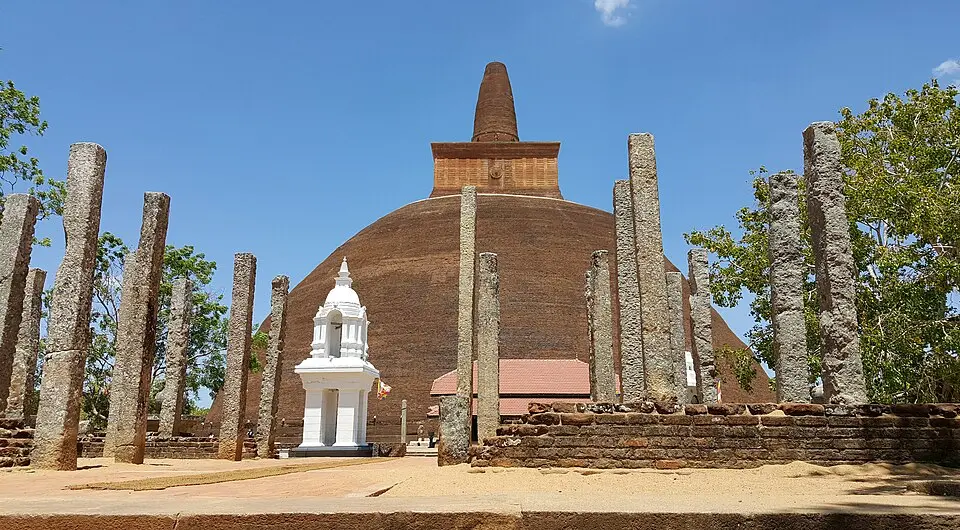
The enormous Abhayagiri Stupa is the principal landmark of the ancient monastery.
Its origins date to the first century BCE, with the monument developing through successive periods of religious patronage and construction.
The massive brick structure demonstrates the engineering knowledge and resources available to ancient Anuradhapura’s builders.
Although much of its appearance reflects centuries of change and conservation, the stupa remains one of Sri Lanka’s most impressive examples of ancient religious architecture.
Explore the stupa alongside the surrounding archaeological remains to appreciate the monastery’s historical significance.
Understanding the Scale of Abhayagiri Stupa
The scale of Abhayagiri Stupa becomes particularly impressive when viewed from the surrounding grounds.
Its enormous brick mass rises above the ancient monastery, reflecting the importance attached to major religious monuments during the Anuradhapura period.
Constructing such a large structure required substantial labour, materials, organisation and technical knowledge.
The stupa also demonstrates the close relationship between monumental architecture and Buddhist religious devotion.
Look at the proportions of the structure and its relationship with the surrounding archaeological remains to appreciate the scale of the institution that developed around it.
Conservation of the Ancient Stupa
Abhayagiri Stupa has undergone extensive archaeological conservation and restoration.
Preserving a monument of this size requires specialist work to protect historic brickwork, structural stability and surviving architectural features.
Conservation is particularly important because centuries of exposure to weather, vegetation and natural deterioration can damage ancient masonry.
The Central Cultural Fund has played a major role in preserving Abhayagiri and other monuments within the UNESCO-listed Sacred City of Anuradhapura.
Visitors should remain on designated paths and avoid climbing onto ancient brickwork or entering restricted conservation areas.
Samadhi Buddha Statue
The Samadhi Buddha is one of Anuradhapura’s most celebrated examples of ancient Buddhist sculpture.
Located within the wider Abhayagiri monastic area, the seated stone image depicts the Buddha in deep meditation.
Its composed expression, balanced proportions and restrained design have made it one of Sri Lanka’s most admired Buddhist artworks.
Unlike the enormous stupas nearby, the sculpture offers a more intimate encounter with ancient Buddhist artistic traditions.
Its importance lies not simply in its beauty but also in the religious meaning expressed through the Buddha’s meditative posture.
What Makes the Samadhi Buddha Special?
The term samadhi refers to deep meditative concentration.
The seated Buddha image communicates this state through a calm expression and carefully balanced posture.
Its artistic simplicity creates a sense of stillness that contrasts with the monumental scale of Abhayagiri’s stupas.
Notice the position of the hands, the facial expression and the overall proportions of the figure.
These details help explain why the Samadhi Buddha is considered an important achievement of ancient Sri Lankan sculpture.
The site also retains religious significance, so visitors should remain quiet and avoid disrespectful photographs or poses.
Kuttam Pokuna: The Twin Ponds
Kuttam Pokuna, commonly known as the Twin Ponds, is one of the finest surviving examples of ancient water engineering in Anuradhapura.
The site consists of two carefully constructed stone-lined ponds associated with the wider Abhayagiri monastic landscape.
Their elegant proportions, broad stone steps and detailed construction demonstrate a sophisticated approach to managing water.
These structures help visitors understand that ancient monasteries depended on carefully organised infrastructure rather than religious monuments alone.
Water was essential for daily activities, hygiene and the functioning of large resident communities.
Ancient Water Engineering at Kuttam Pokuna
The Twin Ponds demonstrate the advanced hydraulic knowledge developed in ancient Anuradhapura.
Stone-lined basins, carefully arranged steps and water-control features reveal the technical skill involved in their construction.
The design also reflects the importance of water within Sri Lanka’s dry-zone environment, where seasonal rainfall required effective management.
Rather than viewing the ponds simply as attractive ruins, consider the planning and construction needed to create reliable facilities within a large monastic settlement.
Pay attention to the stonework and the relationship between the different structural elements.
The ponds are protected archaeological remains and must not be used for swimming or bathing.
Ratna Prasada and Its Architectural Heritage
Ratna Prasada is another important archaeological monument associated with the Abhayagiri complex.
Although much of the original building has disappeared, the surviving foundations and stonework reveal aspects of its former architectural importance.
The site is particularly famous for its elaborately carved guardstone.
These surviving details demonstrate the artistic skill invested in religious and institutional buildings during the Anuradhapura period.
Ratna Prasada is especially rewarding for visitors interested in stone carving and ancient architectural decoration.
The Famous Ratna Prasada Guardstone
One of the most distinctive features associated with Ratna Prasada is its highly decorated stone guardian figure.
Guardstones, known in Sinhala as muragala, were traditionally positioned near entrances to important buildings.
They often incorporated protective religious and symbolic imagery.
The Ratna Prasada guardstone is celebrated for its intricate carving and carefully arranged decorative elements.
Notice the figure, ornamentation and the overall balance of the design.
The craftsmanship reveals how architectural entrances were treated as significant artistic and symbolic spaces rather than purely practical features.
Moonstones and Carved Architectural Details
Abhayagiri contains numerous examples of carved stone elements associated with ancient monastic buildings.
Moonstones, guardstones, pillars and carved architectural fragments provide evidence of how buildings were decorated and arranged.
A moonstone, traditionally known as a sandakadapahana, is a decorated semicircular stone slab commonly associated with entrances to important buildings.
Its carved designs can include animals, floral patterns and other symbolic elements.
These details demonstrate the sophistication of Sri Lankan stone carving and the attention given to the design of religious and institutional spaces.
Residential Buildings and Monastic Life
One of Abhayagiri’s greatest archaeological strengths is the survival of remains associated with everyday monastic activities.
The monastery required residential quarters, communal facilities and spaces for study, administration and religious practice.
Stone foundations and other architectural remains reveal how these functions were organised within a large settlement.
Understanding the purpose of such buildings helps explain Abhayagiri as an active community rather than simply a group of impressive religious monuments.
Monks needed accommodation, food, water, teaching spaces and facilities supporting daily routines.
The surviving remains provide evidence of the organisation required to sustain that community over many centuries.
Abhayagiriya Museum
The Abhayagiriya Museum is one of the most useful places for understanding the archaeological discoveries made within the monastic complex.
Opened on 13 June 1992, the museum was developed by the Central Cultural Fund with financial support from China.
Its design draws on the traditional Panchavasa monastery plan.
The institution was originally known as the Mahatissa-Faxian Cultural Complex, commemorating important figures associated with Abhayagiri’s religious history.
The museum preserves objects recovered through archaeological investigations of the monastery and surrounding areas.
These collections provide valuable context for understanding structures that now survive mainly as foundations, terraces and scattered architectural remains.
What Can You See Inside Abhayagiriya Museum?
The museum contains a varied collection of archaeological objects representing religion, craftsmanship, trade and everyday life.
Exhibits include ancient metal objects, copper items, tools, pottery, jewellery, coins, inscriptions and religious sculptures.
Gold and silver ornaments demonstrate skilled craftsmanship, while ceramic material and architectural fragments reveal details about construction and artistic traditions.
The collection also includes Buddhist religious objects and images of deities associated with the monastery’s historical development.
Rather than concentrating only on individual valuable objects, notice how the displays help reconstruct the wider life of the ancient institution.
Chinese Porcelain and International Trade
Among the museum’s particularly interesting objects are examples of Chinese porcelain discovered in the Abhayagiri area.
These finds provide material evidence of the monastery’s wider connections with overseas networks.
Imported ceramics demonstrate that objects, knowledge and cultural influences travelled between Sri Lanka and other parts of Asia.
Such discoveries are significant because they support the historical picture of Abhayagiri as an internationally connected religious institution.
When viewed alongside Faxian’s connection with the monastery, the objects help illustrate Sri Lanka’s place within broader Asian Buddhist and commercial networks.
What Archaeological Finds Reveal About Ancient Technology
The museum’s collections are important not only for religious history but also for understanding ancient technology.
Metal objects, tools, ceramics and architectural materials provide evidence of specialist skills and manufacturing techniques.
Other discoveries contribute to research into hygiene practices, environmental management, water systems and monastic administration.
These subjects reveal the practical sophistication of a large Buddhist institution operating long before modern infrastructure.
Abhayagiri’s history therefore extends beyond meditation and worship to include technical knowledge, organisation and everyday problem-solving.
Why the Museum Adds Meaning to the Ruins
Many ancient monastic buildings survive only as foundations, pillars or isolated stone features.
Without historical context, it can be difficult to understand their original functions.
Objects recovered from archaeological investigations help connect these physical structures with the activities that once took place around them.
Tools and pottery reveal practical needs, while religious sculpture and decorative objects illustrate artistic and devotional traditions.
The museum provides an opportunity to appreciate these connections and understand Abhayagiri as a functioning historical institution.
The Abhayagiriya Museum is distinct from the main Anuradhapura Archaeological Museum.
Best Time to Visit Abhayagiri Monastery
Early morning and late afternoon are generally the most comfortable times to explore Abhayagiri.
Anuradhapura experiences high temperatures during much of the year, while many archaeological areas are exposed to direct sunlight.
Morning provides softer light and more comfortable walking conditions around the stupa and surrounding monuments.
Late afternoon is also attractive, particularly for photography of the ancient brickwork and stone structures.
The landscape covers a substantial area, so the temperature can make a significant difference to how comfortable the experience feels.
How Long Should You Spend at Abhayagiri?
Allow approximately three to four hours to appreciate the main monuments, archaeological remains and museum.
Travellers with a strong interest in Buddhist archaeology may enjoy spending longer, particularly when examining carved stone details and the museum collections.
Abhayagiri’s monuments are spread across a large archaeological area, so allow time to travel between them.
Even when travelling between areas by tuk-tuk or car, expect some walking within individual archaeological locations.
A relaxed pace gives you enough time to understand the relationship between the different parts of the ancient monastery.
Walking and Transport Around Abhayagiri
The Abhayagiri archaeological landscape covers a large area within Anuradhapura’s Sacred City.
The main monuments are not all grouped within one small enclosed compound.
Travellers can use a bicycle, tuk-tuk or private vehicle to move between different areas.
Cycling is an option for visitors comfortable riding in warm weather and navigating local roads.
A tuk-tuk or hired driver is usually more comfortable during hotter periods or for travellers who prefer less physical exertion.
Agree the tuk-tuk or driver cost before travelling.
Comfortable footwear remains important because some walking is required within the monument areas themselves.
Abhayagiri Entrance Tickets
Abhayagiri is part of the wider UNESCO-listed Sacred City of Anuradhapura.
The Central Cultural Fund manages the main archaeological heritage ticket for international visitors.
Foreign full ticket: US$30
Foreign half ticket: US$15
The foreign half-ticket category applies to children aged 6–12.
These prices relate to the wider Anuradhapura archaeological heritage zone rather than a separately priced Abhayagiri-only ticket.
Keep your admission ticket available while moving between heritage areas, as the ancient city contains monuments at different locations.
Official ticket information and online booking are available through the Central Cultural Fund.
Temple Dress Code and Religious Etiquette
Although much of Abhayagiri is archaeological, several areas retain religious significance.
Visitors should wear modest clothing covering shoulders and knees when entering sacred areas.
Footwear may need to be removed around active religious monuments and shrine precincts.
Hats should also be removed where required by religious rules.
Do not touch Buddha images, climb onto stupas or use sacred structures as seating areas.
Follow the instructions of site officers and give worshippers space during religious activities.
Protecting the Ancient Sculptures
Abhayagiri contains important examples of stone carving and ancient religious sculpture.
These objects have survived centuries of weather exposure and environmental change.
Visitors should never touch carved surfaces, remove fragments or lean against protected architectural features.
Even apparently solid stone can be damaged by repeated contact and careless behaviour.
Observe carvings from permitted areas and use photographs rather than physical contact to record interesting details.
Photography at Abhayagiri
Abhayagiri provides excellent opportunities for photographing ancient architecture, sculpture and archaeological landscapes.
The enormous stupa is particularly striking in softer morning or late-afternoon light.
Smaller archaeological features such as guardstones, moonstones and carved pillars offer interesting subjects for closer architectural photography.
However, photography must respect religious rules and the protection of ancient monuments.
Avoid posing disrespectfully with Buddha images and do not climb onto historic structures for a better viewpoint.
Professional filming and drone photography require the relevant heritage permissions.
What to Wear and Bring
Lightweight clothing is essential for exploring Anuradhapura’s dry-zone archaeological sites comfortably.
Choose breathable clothing that also satisfies Buddhist temple dress requirements.
Wear comfortable walking shoes with good grip that can be removed easily where necessary.
Carry drinking water, sunscreen and a hat for exposed areas.
A small pair of socks may be useful when walking on hot stone surfaces after removing footwear, where permitted.
A compact bag is generally more convenient than carrying heavy luggage between the monuments.
Visiting Abhayagiri with Children
Abhayagiri can be an engaging experience for older children interested in ancient history and archaeology.
The enormous stupa, carved stone guardians and Twin Ponds provide visually interesting examples of ancient engineering and craftsmanship.
Explain that the ruins are protected historical structures rather than places for climbing or playing.
Children should remain supervised around ponds, uneven stones and exposed archaeological areas.
Carry enough water and avoid prolonged walking during the strongest midday heat.
Accessibility and Visitor Comfort
The Abhayagiri area includes ancient stone surfaces, uneven paths, open archaeological grounds and monuments spread across different locations.
Some areas may be easier to access than others, depending on the available approach and the condition of the ground.
Travellers with reduced mobility may find a tuk-tuk or private vehicle particularly useful for moving between monuments.
Individual features such as steps, terraces and uneven stonework can still present difficulties.
The large archaeological landscape can be appreciated at different levels of physical activity without attempting to walk every section.
Why Abhayagiri Matters to Sri Lankan History
Abhayagiri is important because it reveals how sophisticated Buddhist monastic institutions became during the Anuradhapura period.
The complex brought together religious worship, education, residential life, water management, craftsmanship and international cultural connections.
Its stupa demonstrates monumental architectural achievement, while the smaller archaeological remains reveal the daily functioning of the community.
The museum’s collections provide further evidence of technical knowledge, religious scholarship and exchanges with other parts of Asia.
Together, these features make Abhayagiri one of the most valuable places for understanding the wider civilisation that developed around ancient Anuradhapura.
Is Abhayagiri Monastery Worth Visiting?
Yes. Abhayagiri is one of the most rewarding archaeological areas in Anuradhapura, particularly for travellers interested in Buddhist history and ancient civilisation.
Its appeal extends far beyond the enormous Abhayagiri Stupa.
The Samadhi Buddha, Kuttam Pokuna Twin Ponds, Ratna Prasada, monastic foundations and museum collections reveal the religious, artistic and practical achievements of the ancient monastery.
Exploring these different features provides a deeper understanding of how Buddhism influenced everyday life, learning and cultural development in Sri Lanka.
For international visitors, Abhayagiri offers an opportunity to see Anuradhapura not simply as a collection of impressive monuments, but as the remains of a once-thriving centre of religious scholarship and community life.