Explore one of northern Sri Lanka’s most remarkable historic landmarks at Jaffna Fort, where centuries-old stone ramparts, impressive bastions and sweeping lagoon views reveal the city’s complex past.
Originally established by the Portuguese in 1618 and later transformed by the Dutch, Jaffna Fort has witnessed colonial expansion, military conflict and extensive conservation. Today, its surviving fortifications offer visitors a fascinating opportunity to discover the history and architectural heritage of Sri Lanka’s Northern Province.
For more information about the surrounding city, explore our Jaffna Destination Guide.
Location: Central Jaffna, beside Jaffna Lagoon
Best for: History, architecture, photography and cultural heritage
Time needed: Approximately 1.5–2.5 hours
Best time to visit: Early morning or late afternoon
Walking difficulty: Easy to moderate, with uneven surfaces and steps
Historic stone ramparts overlooking Jaffna Lagoon
Why Visit Jaffna Fort?
Jaffna Fort is one of the largest surviving colonial fortifications in Sri Lanka, offering an impressive example of European military architecture in South Asia.
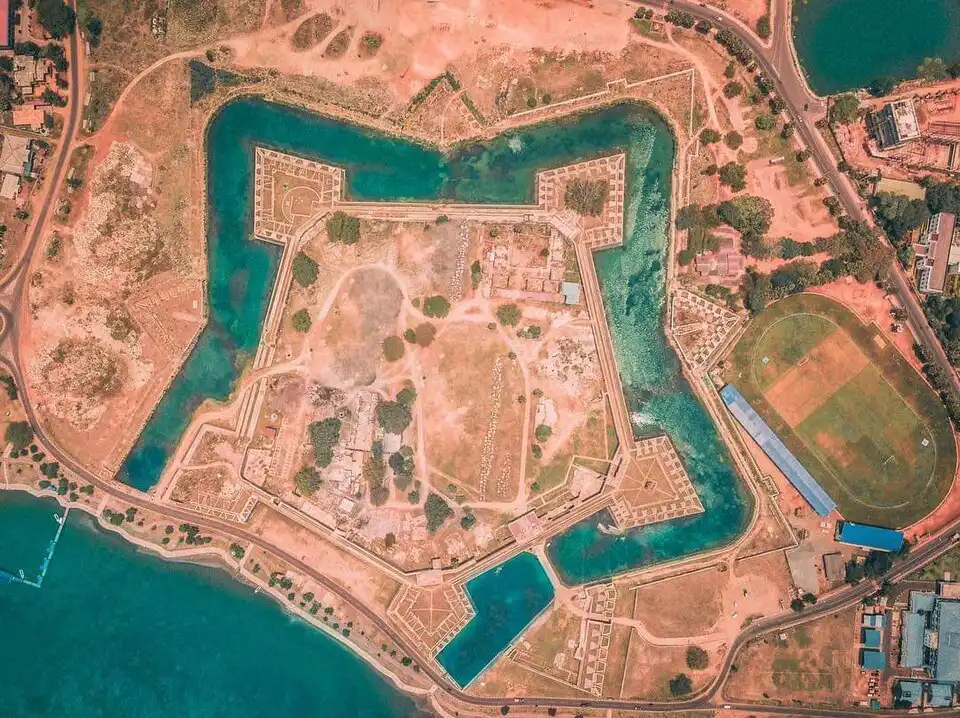
Photo: Varobanu / Wikimedia Commons · CC BY-SA 4.0
Its massive stone walls, projecting bastions and defensive moat reflect the strategic importance of Jaffna during successive periods of colonial rule.
The fort’s location beside Jaffna Lagoon provides beautiful views across the water and surrounding city, particularly during the softer light of late afternoon.
Beyond its architectural features, Jaffna Fort tells a fascinating story of changing political power, military engineering and the preservation of cultural heritage.
Visitors can explore the spacious interior, admire the restored fortifications and discover archaeological remains that reveal different chapters of Jaffna’s history.
The History of Jaffna Fort
The story of Jaffna Fort spans more than four centuries, beginning with Portuguese expansion into northern Sri Lanka during the early seventeenth century.
Portuguese Rule and the First Fort
The Portuguese established the original fort in 1618 after consolidating their control over the Kingdom of Jaffna.
The location beside the lagoon offered strategic advantages for monitoring movement across the surrounding waterways and protecting the colonial administration.
The first fort featured a quadrangular defensive layout, designed to protect Portuguese military and administrative interests.
Its construction marked an important development in the colonial history of northern Sri Lanka.
Dutch Capture and Reconstruction
In 1658, Dutch forces captured Jaffna Fort following a prolonged siege against the Portuguese garrison.
The Dutch East India Company subsequently undertook extensive reconstruction, transforming the earlier defensive structure into a larger and more sophisticated fortress.
The new design featured a pentagonal layout with five projecting bastions, substantial stone ramparts and a surrounding moat.
These improvements strengthened the fort’s defensive capabilities and created much of the architectural character visible today.
Construction and improvements continued during the Dutch period, with the outer defensive works completed towards the end of the eighteenth century.
Jaffna Fort Under British Rule
British forces took control of Jaffna Fort in 1795, bringing another period of colonial administration to the northern region.
The fort continued to serve military and administrative purposes under British rule.
Buildings within the complex included accommodation for officials, military facilities, administrative structures and religious buildings.
The British period added another chapter to the fort’s history before Sri Lanka gained independence in 1948.
Exploring Jaffna Fort’s Defences
The surviving fortifications are among the most impressive features of Jaffna Fort.
The distinctive pentagonal design reflects the principles of European military engineering, with different defensive elements working together to protect the complex.
The Five Bastions
Jaffna Fort features five projecting bastions positioned around its defensive perimeter.
These angular structures allowed defenders to observe the surrounding landscape and protect adjoining sections of the walls.
Their geometric arrangement creates the fort’s distinctive star-shaped appearance when viewed from above.
Today, visitors can appreciate the scale of these structures while exploring permitted sections of the fortifications.
The Ramparts and Moat
The substantial ramparts were constructed using durable masonry, including limestone and coral stone.
Their thick walls provided protection against military attacks and formed an imposing barrier around the interior.
A defensive moat surrounds much of the fort, separating the outer walls from the surrounding ground.
Together, the ramparts and moat demonstrate the importance of defensive engineering during the colonial period.
From permitted elevated sections, visitors can enjoy panoramic views across Jaffna Lagoon, the surrounding city and the fort’s impressive architectural layout.
The Historic Entrance
The main entrance is another distinctive architectural feature.
Its arched gateway and substantial stonework reflect the Dutch colonial design that shaped the fortress.
An inscription bearing the year 1680 remains associated with the historic entrance, providing a visible reminder of the fort’s seventeenth-century reconstruction.
The gateway offers an excellent opportunity to appreciate the scale and craftsmanship of the surviving fortifications.
Inside Jaffna Fort: Historic Buildings and Ruins
Beyond the imposing outer walls, Jaffna Fort contains a spacious interior with the remains of buildings that once supported its military and administrative functions.
Historic structures included the Dutch Reformed Church, commonly known as Kruys Kerk, military facilities and Queen’s House.
Many buildings suffered extensive damage during Sri Lanka’s civil war, leaving foundations, partial walls and other architectural remains.
The surviving ruins reveal the former arrangement of the complex and provide insight into how the fort operated during different periods.
The Dutch Church Ruins
The remains of the historic Dutch church are among the important archaeological features within the fort.
Originally constructed during the Dutch colonial period, the church formed part of the religious and administrative life of the garrison.
Although much of the building was destroyed during the civil war, archaeological work has helped identify and document its surviving foundations and architectural elements.
Queen’s House and Colonial Buildings
Queen’s House was among the administrative and residential buildings associated with the fort’s later history.
Its surviving remains reflect the role of the fortress as a centre of colonial administration.
Other archaeological structures provide evidence of military accommodation, public buildings and the everyday activities of people who lived and worked inside the fort.
These historic remains form an important part of the visitor experience, complementing the better-preserved defensive walls.
Jaffna Fort During the Civil War
Jaffna Fort played a significant role during Sri Lanka’s civil war, which lasted from 1983 to 2009.
Its strategic location made it an important military position during periods of intense conflict in northern Sri Lanka.
The fighting caused substantial damage to the fort, including the destruction of numerous historic buildings within its walls.
The surviving ruins reflect this difficult period in the region’s modern history.
The fort also holds significance for local communities whose lives were affected by the conflict and its lasting consequences.
Understanding this history adds depth to a visit, connecting the site’s colonial heritage with the experiences of contemporary Jaffna.
Archaeological Research and Conservation
Following the civil war, conservation efforts began to protect and restore Jaffna Fort’s surviving structures.
Sri Lankan heritage authorities, working with international partners, have undertaken projects to stabilise the ramparts, repair damaged masonry and document archaeological remains.
Support from the Netherlands has contributed to the preservation of the fort’s important Dutch-period architecture.
Archaeological investigations have also revealed evidence of earlier activity at the site, including material that predates European colonial occupation.
These discoveries highlight Jaffna’s long history of settlement and its connections with wider Indian Ocean trading networks.
The Fort Exhibition Centre
An exhibition centre was inaugurated at Jaffna Fort in March 2022 through cooperation between Sri Lankan heritage authorities and Dutch partners.
Its historical displays were developed to help explain the fort’s construction, military history and conservation.
The interpretation adds valuable context to the surviving structures, allowing visitors to appreciate the changes that have shaped the site over several centuries.
Jaffna Lagoon and the Fort’s Scenic Setting
Jaffna Fort occupies a prominent position beside Jaffna Lagoon, where open water and historic stone fortifications create a distinctive coastal landscape.
The lagoon played an important role in the fort’s original strategic location, providing visibility over surrounding waterways and approaches to the city.
Today, the setting is particularly attractive for visitors interested in photography and scenic walking.
From accessible sections of the ramparts, the views extend across the lagoon and towards the surrounding urban landscape.
During late afternoon, the warm sunlight brings out the textures of the historic stone walls while creating beautiful reflections across the water.
The contrast between the massive fortifications and the peaceful lagoon makes this one of Jaffna’s most memorable heritage settings.
How to Get to Jaffna Fort
Jaffna Fort is located close to the centre of Jaffna, making it accessible for travellers staying in the city.
Walking from Central Jaffna
Visitors staying near the city centre can reach the fort on foot.
The route passes through Jaffna’s urban streets towards the lagoon, with the historic fortress occupying a prominent position along the waterfront.
Walking is most comfortable during the cooler morning or late-afternoon hours.
By Tuk-Tuk
A tuk-tuk is one of the easiest ways to reach the fort from accommodation around Jaffna.
The journey is generally short from central locations, making it convenient for visitors travelling with children or those who prefer limited walking.
Agree on the fare with your driver before departing.
From Jaffna Railway Station
Travellers arriving by train can reach Jaffna Fort by tuk-tuk from the railway station.
The fort is located within the wider central Jaffna area, making it convenient to include during a city sightseeing excursion.
Jaffna is connected to Colombo and other destinations through Sri Lanka’s northern railway network and long-distance road services.
Opening Hours, Admission and Visitor Facilities
Jaffna Fort is generally explored during daylight visiting hours.
Visitors enter through the designated main entrance, where current admission arrangements and permitted visitor areas are displayed.
Carry Sri Lankan rupees in cash for any applicable entrance charge.
Access to individual structures or sections of the ramparts may be controlled to protect archaeological remains and accommodate conservation work.
The fort is a large outdoor heritage attraction with limited shade across much of its interior.
Allow approximately 1.5–2.5 hours to explore the principal fortifications, appreciate the historic structures and enjoy the lagoon views.
For refreshments, restaurants and other services, central Jaffna offers a convenient selection of cafés, shops and local eateries.
Best Time to Visit Jaffna Fort
Early morning and late afternoon are generally the most comfortable times to explore the fort.
Jaffna experiences a warm tropical climate, with strong sunshine making exposed outdoor attractions particularly hot around midday.
Morning Visits
Morning offers pleasant conditions for walking around the fortifications before temperatures rise.
The softer light is also suitable for photographing the stone walls, bastions and architectural details.
Late Afternoon and Sunset
Late afternoon is particularly rewarding for photography and scenic views.
As the sun moves lower, warm light highlights the historic masonry and creates attractive colours across Jaffna Lagoon.
Visitors can enjoy the changing atmosphere from permitted viewing areas while completing their visit within the site’s opening hours.
Seasonal Weather
May to September generally offers favourable weather for exploring Jaffna and the surrounding peninsula.
The northeast monsoon brings more frequent rainfall between approximately October and January, which can affect outdoor sightseeing.
Carry drinking water, sunscreen and a hat throughout the year, particularly when exploring the exposed ramparts.
Photography at Jaffna Fort
Jaffna Fort offers excellent opportunities for architectural and landscape photography.
The pentagonal defensive layout, substantial ramparts and historic entrance provide interesting compositions that highlight the fort’s military engineering.
Wide-angle photographs work particularly well for capturing the scale of the walls and the surrounding moat.
A moderate zoom lens can help isolate architectural details, weathered stonework and distant views across the lagoon.
Late-afternoon light is particularly attractive for photographing the warm colours and textures of the historic structures.
Remain within permitted visitor areas and respect restrictions around sensitive archaeological or security-related locations.
Drone photography requires the relevant authorisations and must comply with Sri Lanka’s aviation and site-specific restrictions.
Visitor Safety and Accessibility
Jaffna Fort is an extensive archaeological site with uneven surfaces, historic stone steps and elevated sections of defensive walls.
Comfortable walking shoes with good grip are recommended, especially when exploring the ramparts.
Stay on established visitor routes and follow barriers around fragile structures or restricted areas.
Visiting with Children
Families can enjoy the fort’s open spaces, impressive architecture and lagoon views.
Children should remain close to an adult when walking near elevated ramparts, steep steps and exposed edges.
Bring sufficient drinking water and allow time for breaks during warmer parts of the day.
Visitors with Reduced Mobility
Some ground-level sections provide opportunities to appreciate the fort’s architecture without climbing the ramparts.
However, uneven surfaces and historic steps may make certain areas challenging for visitors with reduced mobility.
Travelling directly to the main entrance by tuk-tuk or private vehicle is a convenient option for those who prefer to minimise walking.
Exploring Nearby Jaffna Attractions
Jaffna Fort is conveniently located near several other important cultural attractions.
Jaffna Public Library is a short journey away and offers another perspective on the city’s history, architecture and cultural identity.
The library’s elegant white façade and remarkable story make it one of northern Sri Lanka’s most significant civic landmarks.
For more information, explore our Jaffna Public Library History and Visitor Guide.
Travellers can also explore Nallur Kandaswamy Kovil, one of the most important Hindu temples in northern Sri Lanka.
Its colourful architecture, religious traditions and lively festival atmosphere offer a fascinating contrast to Jaffna’s colonial heritage.
For visiting etiquette and practical information, read our Nallur Kandaswamy Kovil Visitor Guide.
Is Jaffna Fort Worth Visiting?
Jaffna Fort is one of northern Sri Lanka’s most important historical attractions, combining impressive military architecture with centuries of political and cultural history.
Its monumental ramparts, surviving colonial structures and beautiful lagoon setting provide a memorable experience for visitors exploring Jaffna.
The fort’s continuing conservation also offers an opportunity to appreciate the importance of preserving Sri Lanka’s diverse architectural and archaeological heritage.
For travellers interested in history, photography and the cultural identity of northern Sri Lanka, Jaffna Fort is an essential stop.