Discover one of northern Sri Lanka’s most significant cultural landmarks at Jaffna Public Library, an elegant white building that represents the city’s remarkable literary heritage, turbulent history and enduring commitment to education.
Located in central Jaffna, close to the historic fort, the library is celebrated for its distinctive architecture and its important place in Sri Lankan Tamil cultural history. Originally established in the 1930s, the institution survived a devastating act of destruction in 1981 and has since been rebuilt as a functioning centre of learning.
For more information about the surrounding city, explore our Jaffna Destination Guide.
Location: Central Jaffna, near Jaffna Fort
Best for: Cultural heritage, history and architecture
Time needed: Approximately 45–60 minutes
Visitor hours: 4:00 pm–6:00 pm
Recommended visiting days: Tuesday–Sunday
Photography: Exterior photography permitted; no photography inside
White domes, books and living memory
Why Visit Jaffna Public Library?
Jaffna Public Library is one of the most important cultural institutions in northern Sri Lanka, offering visitors an opportunity to understand the city’s history through its remarkable educational heritage.
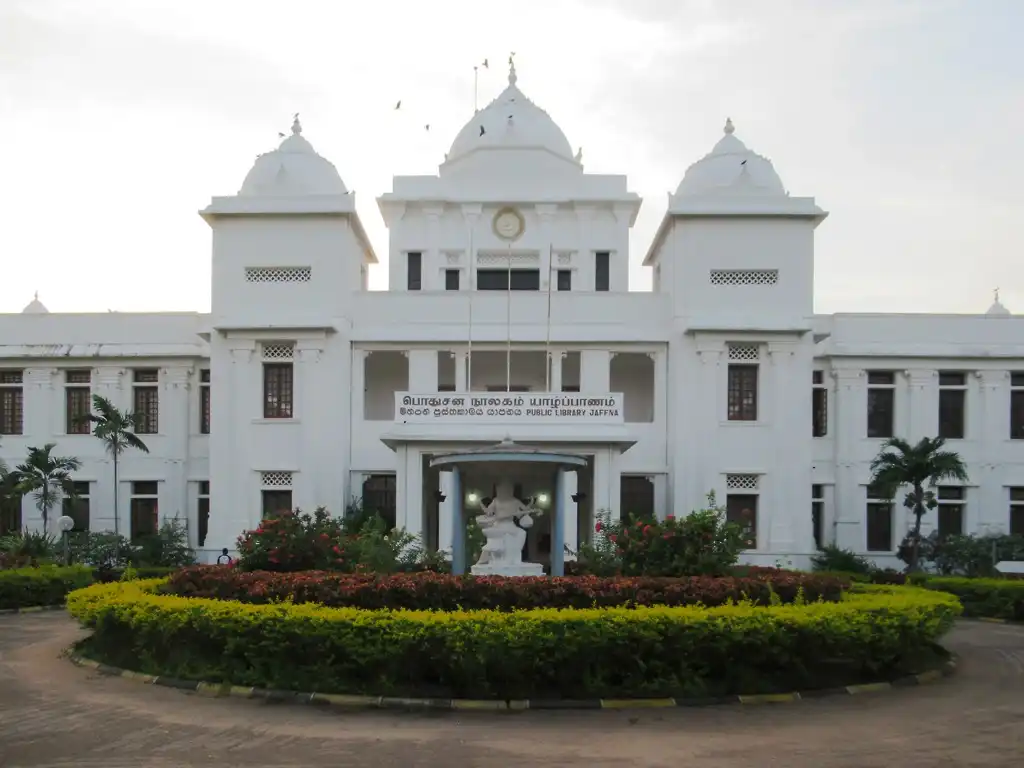
Photo: David Stanley / Flickr · CC BY 2.0 · Edited for brightness and colour.
The beautifully restored building is immediately recognisable for its elegant white façade, symmetrical design and distinctive domes.
Beyond its architectural beauty, the library holds deep significance for Jaffna’s Tamil community. Its history reflects generations of scholarship, the devastating loss of cultural collections and the determination to preserve knowledge for future generations.
Today, the library continues to serve students, researchers and readers, making it an important part of everyday civic life in Jaffna.
For travellers interested in Sri Lanka’s diverse cultural heritage, visiting the library provides a meaningful introduction to the region’s history and identity.
The History of Jaffna Public Library
Jaffna Public Library began in 1934 with a modest collection of 844 books and 36 periodicals.
Established through the efforts of local scholars and community supporters, the institution gradually developed into a major centre of learning.
Over the following decades, its collections expanded to include thousands of books, rare manuscripts, historic newspapers and documents relating to the cultural and intellectual history of northern Sri Lanka.
The library became particularly important for preserving Tamil-language literature and historical material.
By the early 1980s, its collection had grown to approximately 97,000 volumes, making it one of South Asia’s most significant libraries.
Researchers, students and scholars from Sri Lanka and overseas used its collections, reflecting Jaffna’s longstanding reputation as a centre of education and intellectual activity.
The 1959 Library Building and Its Architecture
The library’s most recognisable building emerged from an ambitious development project during the 1950s.
Designed by architect Narasimhan of Madras, India, the new structure incorporated Indo-Saracenic architectural influences.
The first major wing was officially opened in 1959 by Jaffna Mayor Alfred Duraiappah.
Prominent Indian librarian S. R. Ranganathan also contributed advice during the institution’s development, helping establish professional standards for its organisation and services.
Distinctive Architectural Features
The library’s architecture combines an impressive white exterior with symmetrical proportions and elegant domed elements.
Its central entrance, decorative detailing and carefully balanced façade create a striking appearance within Jaffna’s urban landscape.
The surrounding landscaped grounds provide attractive views of the building and opportunities for architectural photography.
The white façade is particularly beautiful during late afternoon, when softer sunlight highlights its distinctive features.
The building remains one of Jaffna’s most recognisable civic landmarks and an important example of twentieth-century institutional architecture in Sri Lanka.
The Burning of Jaffna Public Library in 1981
One of the most tragic events in the library’s history occurred during the night of 31 May to 1 June 1981.
Amid anti-Tamil violence and political unrest in Jaffna, a mob that included members of the Sri Lankan police force deliberately set fire to the library.
The flames destroyed much of the building and approximately 97,000 books and other valuable materials.
Among the losses were rare Tamil manuscripts, historic newspapers, palm-leaf documents and important records of northern Sri Lanka’s cultural heritage.
Some of these materials were unique, making their destruction an irreplaceable loss to scholarship and historical research.
The burning of the library became a deeply significant event in Sri Lankan Tamil history, representing an attack on cultural identity, education and the preservation of knowledge.
Its destruction occurred two years before the beginning of Sri Lanka’s civil war in 1983 and remains an important part of the region’s historical memory.
Rebuilding Jaffna Public Library
Efforts to restore Jaffna Public Library took place over several decades, complicated by the wider conflict affecting northern Sri Lanka.
A major reconstruction programme began in the late 1990s, focusing on restoring the building’s architectural character and rebuilding its collections.
The restored institution reopened to the public in February 2004.
The reconstruction recreated much of the library’s distinctive appearance, including its elegant white façade and architectural features.
Books and educational materials were gradually collected through donations and institutional support, helping the library resume its role as a centre of learning.
Although the original rare manuscripts and unique historical records could not be recovered, the rebuilding of the institution marked an important chapter in Jaffna’s cultural recovery.
Jaffna Public Library Today
Today, Jaffna Public Library continues to serve as an active educational and community institution.
Its facilities support reading, research and the study of literature, history and other academic subjects.
The library maintains collections for different groups of readers and continues to develop services that support access to educational resources.
Students, researchers and members of the local community regularly use the institution, reflecting its continuing importance to Jaffna’s intellectual life.
The restored building also attracts visitors interested in the city’s architecture and cultural heritage.
Its significance lies in both its difficult history and its continuing contribution to education, making it a distinctive destination for travellers exploring northern Sri Lanka.
What Visitors Can See at Jaffna Public Library
The most immediately striking feature is the library’s beautifully restored exterior.
The symmetrical white façade, prominent domes and landscaped surroundings provide excellent opportunities for photography and architectural appreciation.
Visitors can also explore designated interior areas during the permitted visitor period.
Inside, the atmosphere reflects the building’s continuing role as a working library, with reading spaces and collections serving the local community.
Access is organised around normal library activities, with certain reading rooms and collections reserved for registered users.
The experience offers an opportunity to appreciate the building’s architecture while understanding the institution’s cultural and educational significance.
Opening Hours and Visitor Information
Jaffna Public Library has a dedicated visitor period from 4:00 pm to 6:00 pm.
Tuesday to Sunday is generally the most suitable time for visiting, as the main library sections are closed on Mondays and public holidays.
Visitors should enter through the designated entrance and follow staff instructions regarding access to the building.
Allow approximately 45–60 minutes to appreciate the exterior architecture, explore permitted areas and enjoy the surrounding grounds.
The late-afternoon visiting period also provides comfortable conditions for outdoor photography, particularly during warmer months.
Visitor Rules and Etiquette
Jaffna Public Library is a functioning educational institution, and visitors are expected to respect its quiet working environment.
The main visitor requirements include:
- Remove footwear before entering the library.
- Do not take photographs inside the building.
- Keep mobile phones stored and refrain from using them indoors.
- Leave food, carry bags and helmets outside the permitted interior areas.
- Remain within designated visitor spaces.
- Avoid disturbing students, researchers and other library users.
Photography of the building’s exterior is permitted from public areas.
When exploring the grounds, keep entrances clear and respect the privacy of people using the library.
These arrangements help preserve a peaceful environment for both visitors and the local community.
How to Get to Jaffna Public Library
Jaffna Public Library is centrally located near Jaffna Fort, making it convenient to include during a visit to the city’s historic attractions.
Walking from Central Jaffna
Travellers staying near the city centre can reach the library on foot.
The surrounding streets provide an opportunity to experience everyday life in Jaffna while exploring its civic and historical landmarks.
Late afternoon is particularly comfortable for walking, as temperatures begin to ease.
By Tuk-Tuk
A tuk-tuk is one of the easiest ways to reach the library from accommodation elsewhere in Jaffna.
Local drivers are familiar with the landmark, and the journey is generally short from central locations.
Agree on the fare before travelling.
From Jaffna Railway Station
Visitors arriving by train can take a tuk-tuk from Jaffna Railway Station directly to the library.
Travellers exploring the city without a private vehicle can combine the library with Jaffna Fort and other nearby attractions using short tuk-tuk journeys.
Best Time to Visit and Photography Tips
Late afternoon is the ideal time to appreciate Jaffna Public Library, combining the permitted visitor period with attractive natural light.
Jaffna experiences a warm tropical climate, so the cooler hours towards the end of the day are generally more comfortable for walking and outdoor sightseeing.
For exterior photography, a wide-angle composition works well for capturing the full façade and its symmetrical architectural design.
Photographing from the landscaped grounds can also highlight the contrast between the white building and its surrounding greenery.
A moderate zoom lens is useful for capturing the decorative details and domed architectural features.
Respect the library’s interior photography restrictions and avoid blocking entrances or disturbing other visitors.
Accessibility and Visitor Comfort
The library is situated within a relatively flat part of central Jaffna, making the surrounding civic area convenient to explore.
However, pavement conditions and entrance arrangements may vary.
Travellers with reduced mobility may find a tuk-tuk or private vehicle the most comfortable option for reaching the building.
Some internal areas may have access restrictions or architectural features that make movement more challenging.
Wear comfortable footwear for exploring the surrounding streets, and carry drinking water during warm weather.
The library’s afternoon visitor period makes it a convenient cultural stop after exploring other attractions around the city.
Combine Your Visit with Jaffna Fort
Jaffna Public Library is located close to Jaffna Fort, one of northern Sri Lanka’s most impressive historical landmarks.
Originally established by the Portuguese in 1618 and later extensively rebuilt by the Dutch, the fort offers a fascinating insight into the region’s colonial history.
Its massive stone ramparts, defensive bastions and lagoon views provide a contrasting experience to the library’s twentieth-century architecture.
Visiting both attractions offers an opportunity to explore different chapters of Jaffna’s history within the same central area.
For practical information about the fort, explore our Jaffna Fort Colonial History and Visitor Guide.
Is Jaffna Public Library Worth Visiting?
Jaffna Public Library is an essential cultural landmark for travellers interested in the history, architecture and identity of northern Sri Lanka.
Its elegant design, remarkable literary heritage and continuing role in education make it one of the city’s most meaningful attractions.
A visit offers an opportunity to appreciate both the cultural achievements of Jaffna’s past and the importance of preserving knowledge for future generations.