
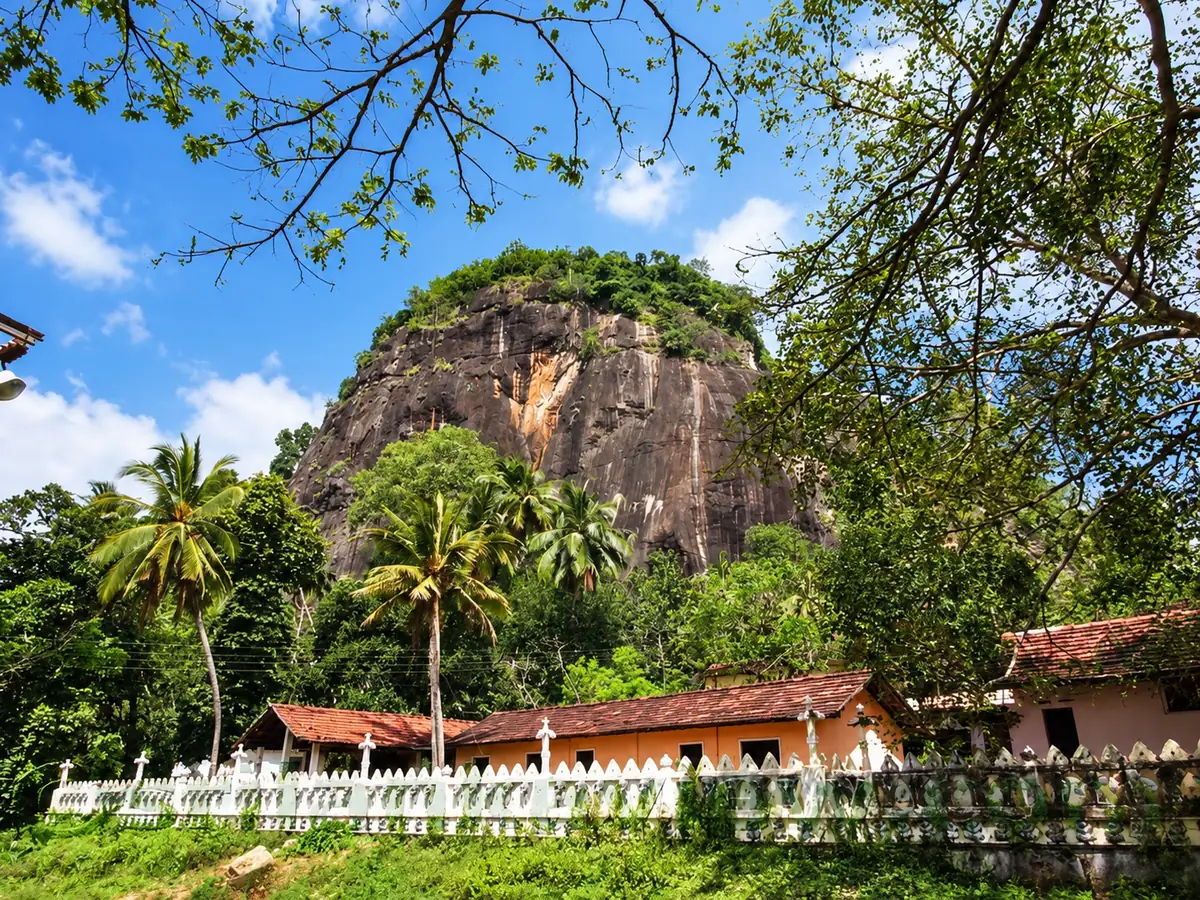
Discover one of southern Sri Lanka’s most remarkable Buddhist heritage sites at Mulkirigala Rock Temple, where ancient cave shrines, beautiful religious paintings and spectacular countryside views await above a towering granite outcrop.
Located inland from Tangalle, Mulkirigala Raja Maha Viharaya is a historic Buddhist monastery featuring seven principal cave shrines arranged across five terraced levels. Visitors climb a series of stone stairways to discover reclining Buddha statues, traditional murals and a peaceful hilltop stupa overlooking the surrounding landscape.
For travellers interested in history, Buddhist culture and distinctive architecture, Mulkirigala offers a rewarding cultural experience away from Sri Lanka’s busy coastal attractions.
Explore our Tangalle Destination Guide for more information about the surrounding area.
Location: Approximately 20 km inland from Tangalle, Southern Province
Best for: Buddhist heritage, cave temples, ancient art and scenic views
Time needed: Approximately 2–3 hours
Best time to visit: Early morning
Climbing difficulty: Moderate, with approximately 500 steps
Dress code: Modest clothing covering shoulders and knees
Ancient cave shrines above southern countryside
Why Visit Mulkirigala Rock Temple?
Mulkirigala is one of the most impressive Buddhist cave-temple complexes in southern Sri Lanka.
The monastery is built around a dramatic natural rock formation rising above forests, villages and agricultural landscapes.
A series of stairways connects the different temple terraces, each revealing historic shrine rooms, religious statues and beautifully painted interiors.
Unlike a conventional temple with buildings arranged around a single courtyard, Mulkirigala unfolds gradually as visitors climb the rock.
Its combination of ancient architecture, religious artwork and elevated viewpoints makes the experience particularly memorable.
The monastery also remains an active Buddhist place of worship, giving visitors an opportunity to appreciate Sri Lanka’s living religious traditions.
The History of Mulkirigala Rock Temple
Mulkirigala has a Buddhist monastic history stretching back more than 2,000 years.
The temple’s early origins are traditionally associated with ancient Sri Lankan kings, particularly King Saddhatissa, who ruled during the second century BC.
Early inscriptions and archaeological remains provide evidence of the monastery’s long religious history.
Over the centuries, Mulkirigala received royal patronage and underwent several periods of renovation.
Restoration During the Kandyan Period
An important period of restoration took place during the reign of King Kirti Sri Rajasinha, who ruled the Kingdom of Kandy from 1747 to 1782.
During this period, several cave shrines were renovated and decorated with religious paintings reflecting Kandyan artistic traditions.
These paintings remain among the monastery’s most distinctive cultural features.
The restoration helped preserve Mulkirigala’s importance as a Buddhist religious centre and contributed to the appearance visitors encounter today.
Mulkirigala and the Mahavamsa
Mulkirigala also holds an important place in the modern study of Sri Lankan history.
In the nineteenth century, a palm-leaf manuscript containing a commentary on the Mahavamsa was found at the monastery.
The Mahavamsa is one of Sri Lanka’s most important historical chronicles, recording the island’s ancient rulers and Buddhist traditions.
The manuscript became an important resource for British civil servant and scholar George Turnour, whose work contributed to the first major English translation of the chronicle in 1837.
This connection gives Mulkirigala significance beyond its religious architecture, linking the monastery with the wider study of Sri Lanka’s recorded history.
The Seven Cave Temples of Mulkirigala
Mulkirigala contains seven principal cave shrines arranged across five terraced levels of the rock.
The natural shelters were adapted into Buddhist religious spaces, with statues, painted walls and decorative architectural features added over different historical periods.
As visitors ascend, each level reveals a different combination of shrine rooms and rock formations.
Reclining Buddha Statues
Several caves contain impressive reclining Buddha images.
These large figures depict the Buddha in a peaceful resting position, surrounded by smaller seated and standing statues.
Their size and detailed craftsmanship are particularly striking within the enclosed cave interiors.
The statues remain sacred objects of Buddhist worship, often accompanied by floral offerings and devotional decorations.
Seated and Standing Buddha Images
Alongside the reclining figures, visitors can admire seated Buddha statues in traditional meditation postures.
Standing images and smaller religious figures appear within several of the shrine rooms.
Together, the sculptures demonstrate the different forms of Buddhist devotional art represented at Mulkirigala.
The natural rock surfaces and enclosed settings create an intimate atmosphere distinct from the large open-air temples found elsewhere in Sri Lanka.
Buddhist Murals and Kandyan-Period Paintings
The paintings at Mulkirigala are among the monastery’s most important artistic treasures.
Several cave interiors feature colourful murals depicting scenes from Buddhist teachings, religious traditions and stories associated with the Buddha’s previous lives.
These narratives, known as Jataka stories, have played an important role in Buddhist religious art for centuries.
Artistic Features of the Murals
The paintings incorporate richly coloured figures, decorative patterns and carefully arranged narrative scenes.
Many reflect artistic traditions associated with the Kandyan period, particularly the eighteenth-century restoration of the monastery.
Religious figures, floral designs and detailed compositions cover sections of the cave walls and ceilings.
The paintings provide valuable insight into the development of Buddhist art in southern Sri Lanka.
Visitors should allow their eyes to adjust to the dimmer interiors before exploring the details of the artwork.
These delicate paintings are part of the temple’s historic fabric and must not be touched.
The Hilltop Stupa and Countryside Views
One of the most rewarding parts of visiting Mulkirigala is reaching the upper section of the rock.
At the summit stands a small Buddhist stupa, surrounded by an elevated landscape of forests, villages and agricultural land.
The panoramic views provide a beautiful contrast to the enclosed cave shrines below.
On a clear day, visitors can appreciate the broad countryside surrounding Tangalle, with green vegetation extending towards the distant coastline.
The upper level also offers an opportunity to experience the peaceful atmosphere of the monastery away from the lower stairways.
The summit remains a sacred religious area, so visitors should approach the stupa respectfully.
The Mulkirigala Climb and Accessibility
Visiting Mulkirigala involves climbing approximately 500 steps across several terraced levels.
The stairways include both constructed steps and sections cut into the natural rock.
Although the ascent is manageable for many travellers with ordinary fitness, some sections are relatively steep.
The climb becomes more demanding during hot weather, particularly on exposed stairways.
How Difficult Is the Climb?
The overall difficulty is moderate.
The route is divided into separate levels, allowing visitors to stop and explore cave shrines between climbing sections.
Allow approximately 2–3 hours for a comfortable visit, including time for the ascent, cave exploration and descent.
Visitors who enjoy walking and can comfortably manage multiple flights of stairs should generally find the experience achievable.
Accessibility Considerations
The full ascent is challenging for travellers with significant mobility limitations because of the steep steps and uneven surfaces.
There is no lift or alternative vehicle route to the upper terraces.
Visitors who cannot complete the entire climb may still appreciate accessible lower sections of the monastery, depending on their individual mobility.
Take particular care when descending, as some steps are uneven and may become slippery after rain.
What to Bring
Carry drinking water, sunscreen and a lightweight bag.
Comfortable footwear with good grip is useful for the stairways, although shoes must be removed when entering designated sacred areas.
Socks can provide additional comfort on hot stone surfaces where permitted.
A hat is helpful while climbing exposed sections but should be removed inside religious shrines.
Best Time to Visit Mulkirigala
Early morning is the most comfortable time to visit Mulkirigala Rock Temple.
Temperatures are generally lower, making the climb easier before the strongest midday sunshine.
The softer morning light also creates attractive conditions for photography around the rock formations and surrounding countryside.
Seasonal Weather
Mulkirigala can be visited throughout the year.
December to March generally provides favourable weather conditions along Sri Lanka’s southern coast, making these months particularly convenient for travellers staying around Tangalle.
The southwest monsoon can bring increased rainfall to parts of the southern region between May and September.
Rainfall may make exposed stone stairways slippery, while hot sunny conditions can increase the physical effort required for the climb.
An early start remains the best option during most of the year.
Entrance Fees and Visiting Information
Mulkirigala is an active Buddhist monastery that also welcomes cultural visitors.
Foreign visitors should be prepared to pay an admission charge at the temple entrance and carry Sri Lankan rupees in cash.
The monastery is best visited during normal daytime hours, with early morning particularly suitable for climbing and exploring the cave shrines.
Some shrine rooms may be opened or supervised by temple custodians.
Allow sufficient time to explore respectfully without interfering with religious activities.
A local guide can also provide useful explanations of the monastery’s history, cave paintings and Buddhist traditions.
For travellers visiting Mulkirigala for the first time, guided interpretation can make the different terraces and religious artwork considerably more meaningful.
How to Get to Mulkirigala from Tangalle
Mulkirigala Rock Temple is located approximately 20 kilometres inland from Tangalle.
The journey usually takes around 30–40 minutes by road, depending on the departure point and traffic.
The route passes through rural communities, small villages and agricultural landscapes, offering an interesting contrast to the nearby coastline.
By Tuk-Tuk
A tuk-tuk is one of the most convenient transport options from Tangalle.
Local drivers can take visitors directly to the temple entrance and arrange a return journey after the visit.
Agree on the total price before departing, including any waiting time while you explore the monastery.
By Private Car
A private car or arranged transfer is particularly convenient for families and travellers staying outside central Tangalle.
Accommodation providers can often assist with arranging transport or a local sightseeing driver.
Travelling by private vehicle also allows greater flexibility when combining Mulkirigala with other attractions in the area.
By Public Transport
Public buses connect Tangalle with inland towns such as Beliatta and Weeraketiya.
Travellers using public transport can continue towards Mulkirigala through local services and short tuk-tuk journeys.
A direct tuk-tuk or private transfer is generally the simplest option for international travellers unfamiliar with the local bus network.
Dress Code, Photography and Temple Etiquette
Mulkirigala remains a functioning Buddhist monastery, and respectful behaviour is expected throughout the visit.
Wear modest clothing covering your shoulders and knees.
Remove footwear and hats when entering designated sacred areas.
Keep your voice low inside the cave shrines and allow monks and worshippers sufficient space for religious activities.
Respecting Buddha Images
Buddha statues should be treated as sacred religious objects.
Avoid posing for photographs with your back directly towards Buddha images, as this is considered disrespectful in Sri Lankan Buddhist tradition.
Do not climb onto statue platforms, touch religious objects or enter restricted shrine areas.
When sitting inside a temple, avoid pointing the soles of your feet directly towards Buddha statues.
Photography at Mulkirigala
The rock stairways, historic buildings and surrounding countryside provide excellent photography opportunities.
Inside the cave temples, photography may be restricted to protect fragile paintings and maintain the peaceful religious atmosphere.
Ask temple staff for permission before photographing shrine interiors.
Avoid flash photography around murals and religious artwork.
Do not photograph monks or worshippers closely without their consent.
Professional filming and drone photography may require separate permission from the relevant authorities.
Visiting Mulkirigala with Children
Mulkirigala can be an enjoyable cultural attraction for families, particularly older children who are comfortable climbing stairs.
The cave temples, large Buddha statues and summit views provide opportunities to learn about Sri Lanka’s Buddhist heritage.
However, the long stairways and tropical heat require careful planning.
Parents should supervise children closely on steep sections and around fragile historic structures.
Younger children may find the ascent tiring, so allow regular breaks and carry sufficient drinking water.
The most comfortable family visits begin early in the morning when temperatures are cooler.
Mulkirigala or Dambulla Cave Temple?
Mulkirigala and Dambulla are both important Buddhist cave-temple destinations, but they offer different visitor experiences.
Dambulla is a UNESCO World Heritage Site known for its extensive collection of religious paintings and more than 150 Buddha statues within five principal caves.
Mulkirigala offers a more secluded atmosphere, with its seven cave shrines arranged along a steeper rock ascent overlooking southern Sri Lanka’s countryside.
For travellers exploring the Cultural Triangle, Dambulla is an important historical attraction.
For visitors staying around Tangalle, Mulkirigala provides an accessible opportunity to appreciate Buddhist cave art without travelling far inland.
Both temples offer valuable insights into Sri Lanka’s religious and artistic traditions.
Is Mulkirigala Rock Temple Worth Visiting?
Mulkirigala Rock Temple is one of the most rewarding cultural attractions near Tangalle.
Its ancient cave shrines, beautifully preserved religious artwork and impressive hilltop views combine to create a memorable experience of Sri Lanka’s Buddhist heritage.
For travellers looking to explore beyond the southern beaches, Mulkirigala offers a fascinating journey through more than two thousand years of religious history.