
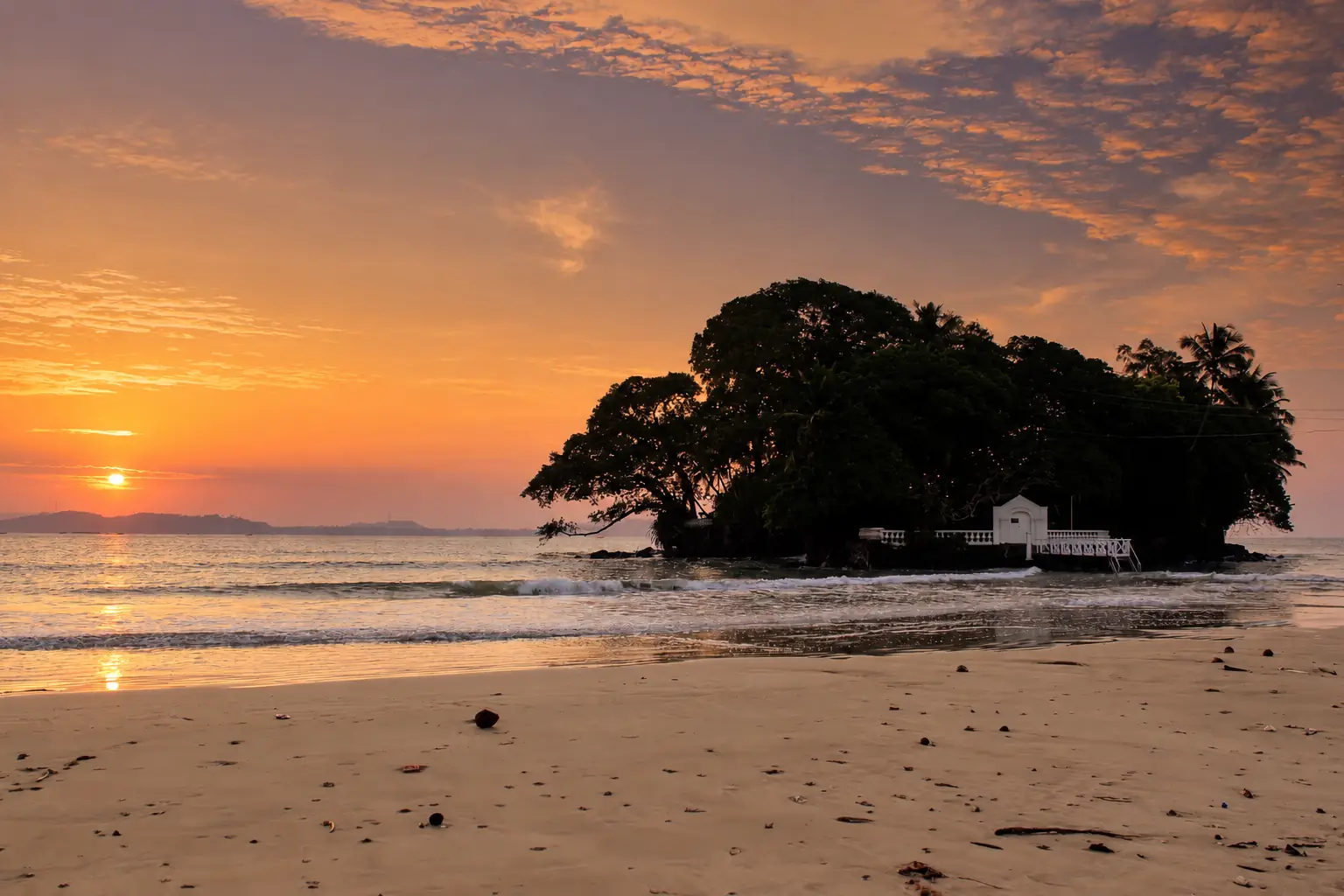
Discover Taprobane Island, one of Sri Lanka’s most distinctive coastal landmarks, where a historic private villa rises above the turquoise waters of Weligama Bay.
Situated approximately 180 metres offshore, this small, tree-covered island is famous for its elegant twentieth-century architecture, tropical gardens and fascinating literary connections. Once the private retreat of a French aristocrat, it later became home to the celebrated American writer Paul Bowles.
Although the island is privately owned, travellers can admire its beautiful setting from Weligama’s public shoreline, making it an interesting cultural and photography stop along Sri Lanka’s southern coast.
For more information about the surrounding area, explore our Weligama Destination Guide.
Location: Weligama Bay, Southern Province, Sri Lanka
Best for: Coastal photography, architecture and literary history
Distance offshore: Approximately 180 metres
Time needed: Approximately 30–60 minutes
Best time to visit: Early morning or late afternoon
Best season: December–April
Entrance fee: Free for public shoreline viewing
Island access: Private property; permission required
Getting there: Walking, tuk-tuk or private vehicle
Historic island villa beyond Weligama’s shore
Why Visit Taprobane Island?
Taprobane Island is one of the most recognisable landmarks along Sri Lanka’s southern coastline.
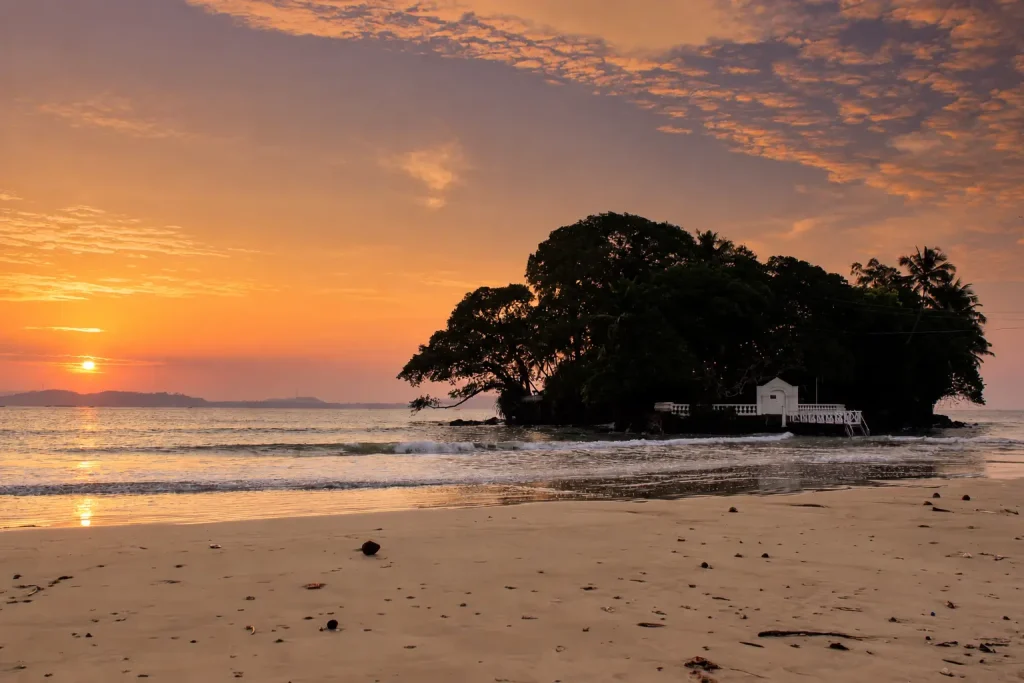

The small rocky island sits just offshore from Weligama Beach, surrounded by the Indian Ocean and covered in tropical vegetation.
Hidden among its trees is a historic white villa, creating an unusual scene that has attracted writers, artists and travellers for generations.
Unlike Sri Lanka’s larger historical attractions, Taprobane is best appreciated as a scenic coastal landmark rather than a traditional sightseeing complex.
Its appeal lies in the combination of beautiful surroundings, distinctive architecture and an extraordinary history.
For travellers staying in Weligama, the island provides an opportunity to discover a fascinating part of the town’s heritage while enjoying views across the bay.
The History of Taprobane Island
Taprobane Island’s modern history began during the 1920s, when Frenchman Maurice Talvande, who styled himself Count de Mauny-Talvande, discovered the small island off Weligama.
Having first visited Ceylon in 1912, he developed a strong affection for the island’s tropical landscapes.
Following the First World War, he returned in search of a peaceful place where he could establish a private retreat.
He eventually found the small rocky island in Weligama Bay, whose secluded appearance and natural beauty appealed to him.
Count de Mauny-Talvande
Around 1925, Count de Mauny acquired the island and began transforming it into an elegant tropical residence.
He commissioned a distinctive villa, landscaped the surrounding grounds and established a retreat that reflected his appreciation for architecture, nature and outdoor living.
The property became a gathering place for international visitors, including aristocrats, artists and prominent figures travelling through Ceylon.
His vision transformed a small coastal island into one of the region’s most unusual private residences.
Why Is It Called Taprobane?
Before its development, the island was known locally as Galduwa, a Sinhala name meaning Rock Island.
Count de Mauny renamed it Taprobane, drawing inspiration from an ancient Greek name historically associated with Sri Lanka.
The name connected his small private retreat with the island nation’s long history in classical geographical accounts.
Today, Taprobane remains one of Weligama’s best-known coastal landmarks.
Architecture of the Taprobane Island Villa
The villa is one of the island’s most remarkable features.
Designed in a neo-Palladian style, the residence combines classical architectural influences with a layout suited to Sri Lanka’s tropical climate.
Its distinctive octagonal design was intended to maximise views, natural ventilation and the connection between indoor and outdoor spaces.
The Octagonal Villa
The house is arranged around a central living area, with rooms extending towards the surrounding verandahs.
This design allows views across Weligama Bay and the Indian Ocean from different sides of the building.
The open arrangement encourages natural airflow, while the verandahs create shaded spaces overlooking the water.
The architecture reflects an early approach to tropical living in which the surrounding landscape became an important part of the residence.
Tropical Gardens and Terraces
The villa is surrounded by carefully landscaped gardens containing palms, flowering plants and other tropical vegetation.
Terraces extend towards the rocky edges of the island, creating beautiful views across the bay.
From the mainland, the white building is partly concealed by mature trees, giving the island its distinctive appearance.
A Historic Private Residence
The property contains five bedrooms and has operated as exclusive private accommodation.
Its architecture, gardens and coastal setting distinguish it from conventional hotels and beach resorts.
Although the villa’s history and design can be appreciated from outside, its interior and grounds are not open for ordinary public sightseeing.
Paul Bowles and Taprobane’s Literary History
Taprobane Island developed an important literary connection during the twentieth century.
In 1952, the American writer and composer <Entity category=”people” value=”Paul Bowles”/> purchased the island.
Bowles was already internationally recognised for his novel <Entity category=”book” value=”The Sheltering Sky”/>, published in 1949.
He spent periods living on Taprobane while maintaining connections with his home in Tangier, Morocco.
Writing on Taprobane Island
The island provided Bowles with a secluded environment for writing.
During his ownership, he worked on <Entity category=”book” value=”The Spider’s House”/>, his novel published in 1955.
The peaceful surroundings offered a contrast to the busy urban settings and political tensions that featured in much of his literary work.
Bowles also wrote about his experiences of island life, describing the attraction of a quiet retreat surrounded by the ocean.
The Island’s Later History
Bowles sold Taprobane Island in 1957.
The property subsequently passed through different owners and continued attracting people associated with literature, art and international cultural circles.
Following periods of neglect, restoration work helped preserve the villa and its distinctive architectural character.
Today, Taprobane’s history remains an important part of Weligama’s cultural identity.
Can Tourists Visit Taprobane Island?
Taprobane Island is privately owned and is not a public tourist attraction.
Travellers can enjoy excellent views of the island from Weligama’s public shoreline without entering the property.
Visiting the Island and Villa
The property has historically operated as exclusive private accommodation rather than a conventional sightseeing attraction.
Admission to the island is restricted to people with the appropriate authorisation.
The property’s official website currently states that it is undergoing maintenance and is not accepting accommodation bookings.
Further information about the property and its accommodation arrangements is available through the official Taprobane Island website.
Can You Walk Across to the Island?
Taprobane Island is separated from the mainland by a relatively narrow stretch of water.
The property’s historical access arrangements include wading through the shallow surf during suitable conditions.
However, this does not make the island publicly accessible.
Water depth, waves and currents can change, while submerged rocks and uneven surfaces may create hazards.
Visitors without permission should remain on the public shoreline rather than attempting to cross.
Best Viewpoints and Photography Opportunities
The public beachfront directly opposite Taprobane Island provides the most convenient viewpoint.
From here, visitors can admire the island’s dense tropical vegetation, rocky shoreline and glimpses of its distinctive white villa.
The surrounding water creates a beautiful contrast with the greenery, particularly during favourable weather.
Viewing from Weligama Beach
Walk along the public shoreline towards the section of the bay facing Taprobane Island.
The island is easily recognisable because of its isolated position close to the beach.
Different positions along the sand provide opportunities to capture the island against the open water or include a wider section of the coastline.
Choose public access areas and avoid crossing private hotel grounds or restricted property.
Photography Tips
Early morning often provides attractive natural light and a peaceful coastal atmosphere.
Late afternoon can create warmer colours across the sea and surrounding shoreline.
A wide-angle lens is useful for photographing the entire island within Weligama Bay.
A moderate zoom lens can capture the villa’s architectural details from the beach.
Avoid photographing private guests closely or using drones over the property without the necessary permissions.
Respect Local Activities
Weligama Bay remains an active coastal community where fishing, surfing and tourism take place alongside one another.
When taking photographs, avoid obstructing fishing boats, working areas or access routes used by local residents.
Respect the privacy of people visiting the beach and the neighbouring private properties.
How to Reach the Taprobane Island Viewpoint
Taprobane Island is located close to the main coastal area of Weligama, making it accessible for visitors staying in the town.
The viewing area can be reached on foot, by tuk-tuk or by private vehicle.
Walking from Central Weligama
Travellers staying around central Weligama can walk towards the public beach directly opposite Taprobane Island.
Allow approximately 10–20 minutes, depending on your starting point.
The route passes through Weligama’s coastal streets and beachfront surroundings.
Walking is particularly pleasant during the cooler morning or late-afternoon hours.
From Weligama Railway Station
Weligama Railway Station lies on Sri Lanka’s southern coastal railway line.
Train services connect the town with destinations including Colombo, Galle and Matara.
From the station, visitors can continue towards the beachfront on foot or take a short tuk-tuk journey.
By Tuk-Tuk
A tuk-tuk is a convenient option for visitors staying outside central Weligama.
Ask the driver to take you to a public beach access point opposite Taprobane Island.
Agree on the fare before travelling.
From Mirissa and Galle
Travellers staying in Mirissa or Galle can reach Weligama using local buses, tuk-tuks or private transfers.
The island is a convenient short stop for visitors exploring Sri Lanka’s southern coastline.
For travellers carrying luggage, a private vehicle offers additional flexibility.
Best Time to Visit and Practical Tips
Taprobane Island can be viewed throughout the year.
However, weather conditions and the time of day influence the appearance of the coastline and the quality of photographs.
Best Season
December to April generally offers favourable weather for exploring Sri Lanka’s southern coast.
This period is particularly attractive for coastal walks, photography and sightseeing around Weligama.
During the southwest monsoon, approximately May to September, the region can experience stronger winds, rain and rougher seas.
The island remains visible from the mainland throughout the year.
Best Time of Day
Early morning is ideal for visitors who prefer quieter surroundings and softer light.
Late afternoon is also rewarding, with warm sunlight creating attractive coastal scenes.
Allow approximately 30–60 minutes to enjoy the viewpoint, take photographs and walk along the nearby shoreline.
Entrance Fees
There is no entrance fee to view Taprobane Island from the public beach.
Visitors may have to pay separately for parking, transport or other commercial services.
The private island and villa do not provide general public admission.
What to Bring
A visit requires very little preparation.
Useful items include:
- A camera or smartphone.
- Sunscreen and sunglasses.
- A hat and drinking water.
- Comfortable footwear for walking.
- Cash for local transport and refreshments.
The main facilities, including restaurants, cafés and shops, are available within Weligama town.
Nearby Attractions in Weligama
Taprobane Island is conveniently located near several of Weligama’s most interesting attractions.
Kushtarajagala
Kushtarajagala is an ancient rock-carved Buddhist sculpture associated with Mahayana religious traditions.
Its impressive standing Bodhisattva figure offers an insight into Sri Lanka’s early medieval artistic heritage.
Explore our Kushtarajagala Weligama Cultural Site Visitor Guide.
Weligama Bay
Weligama Bay is one of Sri Lanka’s best-known destinations for beginner surfing.
Its broad sandy coastline, surf schools and relaxed beach atmosphere attract international travellers throughout the main southern surfing season.
Read our Learning to Surf in Weligama Bay Guide.
Midigama Surf Breaks
Located west of Weligama, Midigama offers a collection of established reef breaks popular with intermediate and advanced surfers.
Its relaxed coastal atmosphere makes it an appealing destination for travellers exploring the wider Weligama coastline.
Discover more in our Midigama Surf Breaks Guide.
Is Taprobane Island Worth Visiting?
Taprobane Island is one of Weligama’s most distinctive coastal landmarks, combining elegant twentieth-century architecture with fascinating literary history.
Its tropical setting and beautiful shoreline views make it a rewarding short cultural and photography stop for travellers exploring Sri Lanka’s southern coast.