Location: Rumassala Hill above Unawatuna
Best for: Buddhist culture, coastal views and quiet reflection
Time needed: Around 45–90 minutes
Important: Dress modestly and treat it as an active religious site
Why Visit the Japanese Peace Pagoda?
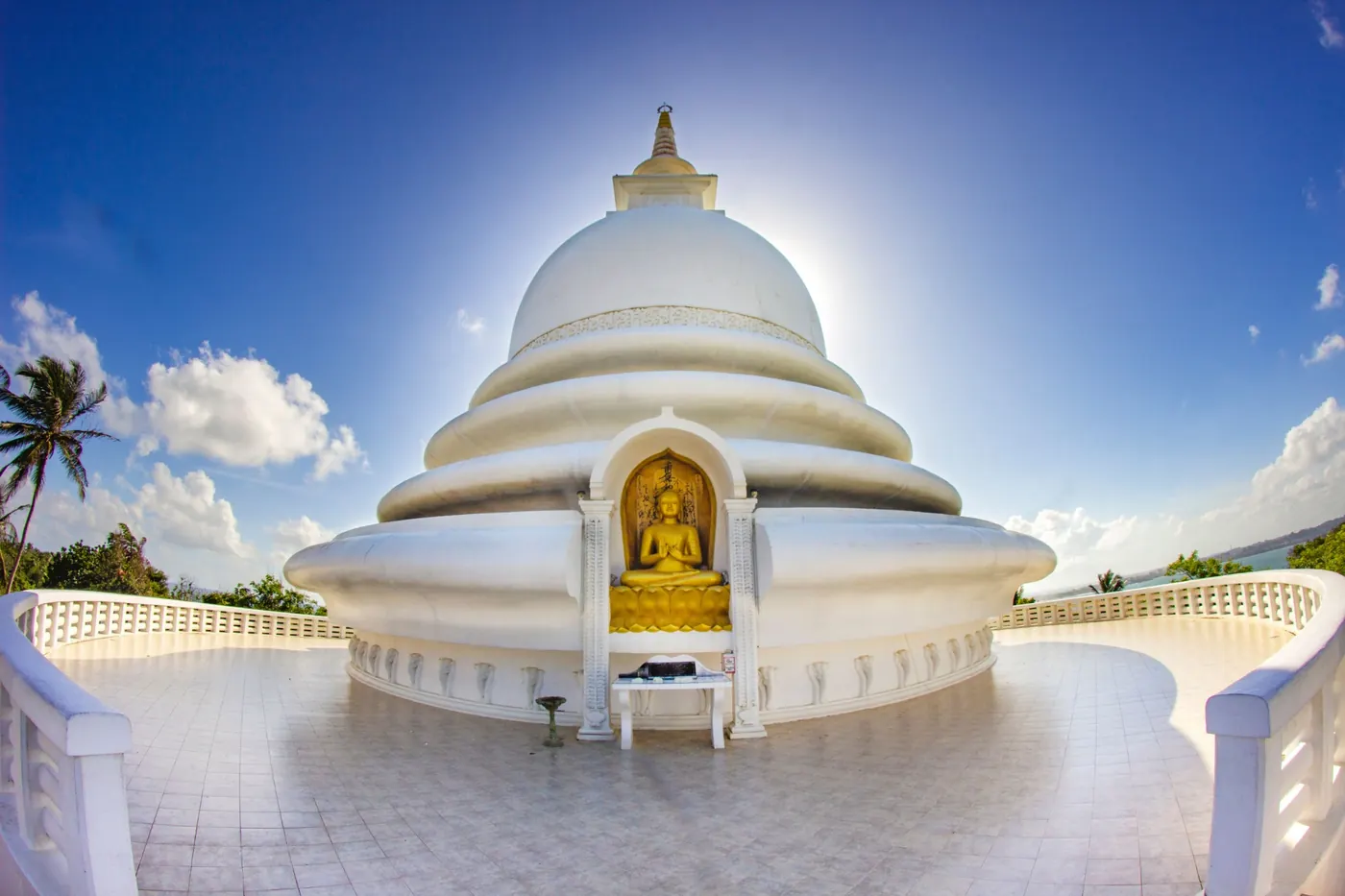
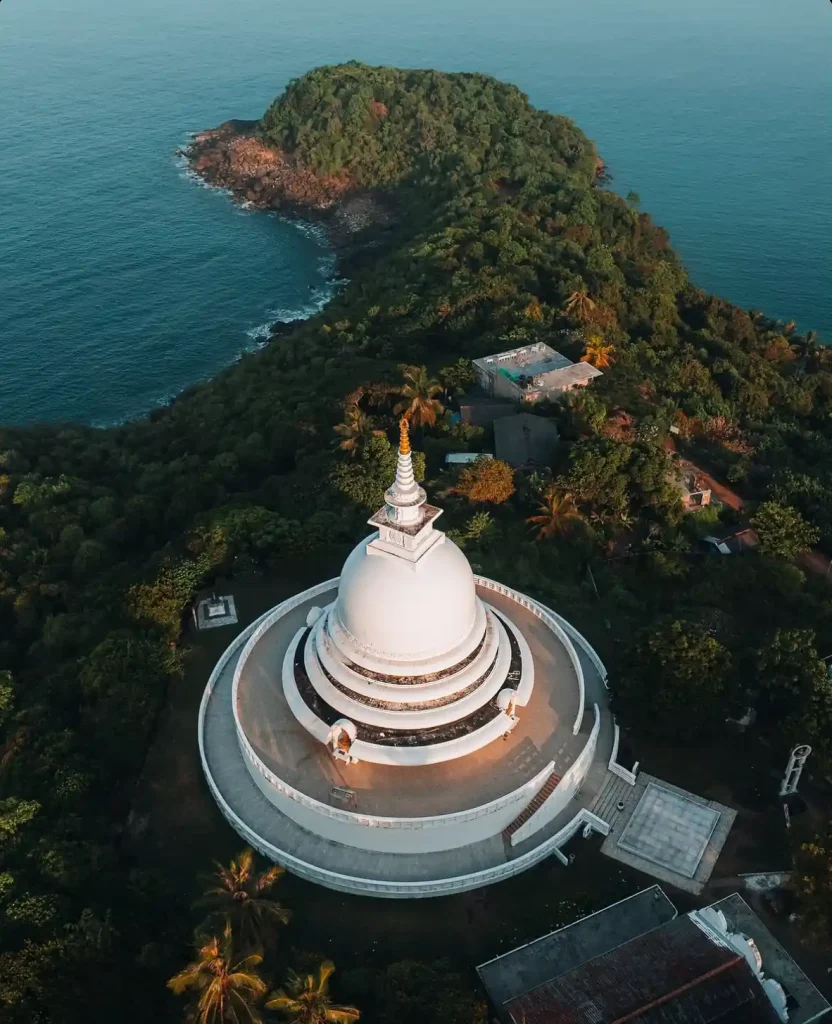
The Japanese Peace Pagoda is one of Unawatuna’s most recognisable hilltop landmarks.
The white stupa stands on Rumassala above the coast, with views towards the Indian Ocean and the wider Galle area.
Its setting makes it easy to combine with Rumassala’s forest trails, viewpoints and Jungle Beach.
The viewpoint is only part of the experience. The pagoda is also a Buddhist place of worship and a monument associated with the international Peace Pagoda movement.
Visit quietly first and take photographs second.
The Peace Pagoda Movement
Peace Pagodas are associated with the Japanese Buddhist organisation Nipponzan-Myōhōji and the peace movement inspired by the monk Nichidatsu Fujii.
The movement developed after the Second World War around the idea of building stupas as symbols of peace and non-violence.
The Rumassala Peace Pagoda belongs to that wider international tradition.
It is better understood as a modern Buddhist peace monument rather than simply as a generic Japanese temple.
When Was the Rumassala Pagoda Built?
The Rumassala Peace Pagoda is a modern monument dating from the early 2000s, commonly around 2005.
It should not be described as an ancient temple.
Its significance comes from the modern Buddhist peace movement, the symbolism of the stupa and its dramatic coastal setting above Unawatuna.
The much older religious and cultural legends associated with Rumassala should be understood separately.
What to Wear at the Peace Pagoda
Cover your shoulders and knees when visiting.
If you are coming directly from Unawatuna Beach, carry a sarong or another suitable layer rather than arriving in swimwear.
Remove hats where appropriate and follow any current instructions regarding footwear near shrine areas.
Respectful clothing is important because this remains an active Buddhist religious site.
How to Behave Around the Stupa
Walk calmly around the site and keep your voice low.
Do not climb onto the stupa base, sit on sacred structures or use Buddha statues as props for photographs.
If worshippers are chanting, praying or making offerings, give them enough space.
You do not need to participate in religious rituals to visit respectfully.
Photography at the Japanese Peace Pagoda
The white stupa against the blue sea and green Rumassala landscape makes the pagoda one of the area’s most striking photographic subjects.
Take wider photographs from the outer areas rather than blocking walkways around the shrine.
Avoid photographing worshippers closely without permission.
If signs, monks or temple staff restrict photography in any part of the complex, follow the instruction immediately.
Best Time to Visit
Early morning is ideal if you want cooler temperatures and a quieter atmosphere.
Late afternoon can provide softer light across the coast and works particularly well as part of a Rumassala half-day.
Midday is hotter, and the bright white surfaces of the pagoda can create strong glare.
If you are combining the pagoda with Jungle Beach, visit the pagoda before or after the hottest part of the day rather than walking through Rumassala at midday.
Opening Hours
A clearly maintained official daily opening-hours schedule was not available in the sources checked for this guide.
Different third-party websites publish different times, so it is better not to rely on one fixed schedule as permanent information.
If you are planning a very early sunrise visit or a late-evening stop, confirm access locally the day before.
Entrance Fee
No standard official tourist ticket was confirmed for the Japanese Peace Pagoda.
Some recent visitor guides describe access as free, but current donation or temple arrangements can change.
Follow any instructions displayed when you arrive.
A voluntary temple donation should not be confused with a government admission ticket.
How to Get to the Japanese Peace Pagoda
A tuk-tuk can take you close to the pagoda using the Rumassala road network.
Agree the tuk-tuk or driver cost before travelling.
Walking is also possible from the Unawatuna and Jungle Beach side, although some routes can be steep, hot and uneven.
Map apps are useful for orientation, but they may sometimes route visitors through small roads or private-looking access points.
Follow established public paths and current signs rather than taking uncertain shortcuts.
Walking from Jungle Beach
The Japanese Peace Pagoda and Jungle Beach are close enough to combine in the same outing.
The forested route through Rumassala is more interesting than simply driving between the two, but sections can become slippery after rain and hot later in the day.
Carry drinking water and wear shoes or sandals with good grip.
Avoid cliff-edge shortcuts simply because they appear shorter on a phone map.
Views Towards Galle
The pagoda’s elevated position gives visitors a useful view across the coastline towards Galle.
On a clear day, you can see how closely Unawatuna’s beach area sits to the historic city and harbour.
This makes the pagoda a useful stop early in an Unawatuna stay because it helps you understand the geography of the coast before visiting Galle Fort.
The Rumassala Legend
Rumassala is associated with the Ramayana tradition in which Hanuman is said to have carried part of a Himalayan mountain.
This story forms part of the area’s religious and cultural identity.
It should be understood as legend rather than scientific geology.
The story is worth knowing, but it should not replace Rumassala’s documented biodiversity or the modern Buddhist importance of the Peace Pagoda.
Combine the Pagoda with Jungle Beach
A practical half-day can begin at the Peace Pagoda during the cooler morning hours.
After the visit, follow an established route towards Jungle Beach.
Swim only if sea conditions are suitable.
Return by the same safe route or use road transport rather than improvising through unfamiliar forest paths.
This combination gives you Buddhist culture, coastal walking and beach time without needing a full-day excursion.
Combine the Pagoda with Unawatuna Beach
If you prefer less walking, visit the pagoda by tuk-tuk and return to Unawatuna’s main bay afterwards.
This works particularly well in the late afternoon after a relaxed beach day.
The pagoda adds a cultural experience without requiring a major journey away from Unawatuna.
Families and Accessibility
The pagoda itself can be relatively straightforward to visit once you reach the site.
The walking approaches through Rumassala, however, are not suitable for everyone.
Families with younger children and travellers with limited mobility may find road access easier than walking through the forest.
Ask your driver for the closest permitted drop-off point and expect some walking depending on current access arrangements.
Responsible Visiting
Carry all rubbish away with you.
Do not carve or write on structures, tie objects to trees without religious permission or leave food around the site.
Respect nearby residents and any monastic activity.
Even when the viewpoint becomes busy, the pagoda should remain a calm and respectful place.
Is the Japanese Peace Pagoda Worth Visiting?
Yes, particularly if you are already staying in Unawatuna.
It is a short cultural stop with excellent coastal views and a very different atmosphere from the main beach.
The experience becomes more meaningful when you understand the pagoda’s Buddhist peace tradition and combine it with Rumassala’s forest and coastal landscape.
It is best approached as a religious and cultural site rather than simply as a place for photographs.