
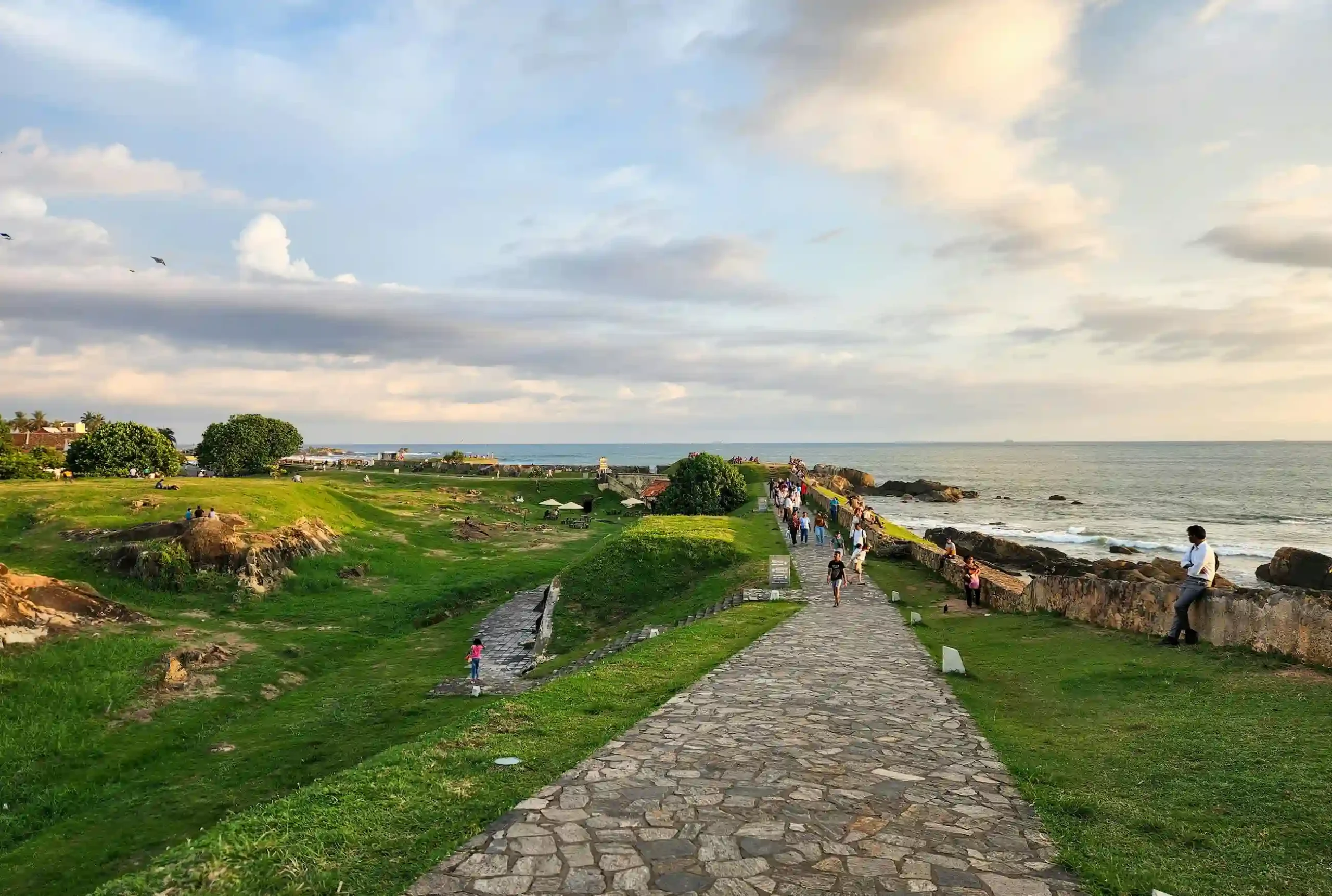
Explore Galle Fort’s UNESCO-listed ramparts with practical guidance on bastions, defensive design, historic materials, sea views, photography, walking conditions and responsible access within this living World Heritage town.
Location: Galle Fort, Southern Province
Best for: History, architecture, walking and sea views
Time needed: Around 2–3 hours for an unhurried exploration
Best conditions: Early morning or late afternoon
General access: Public streets and ramparts are free to explore
Historic walls between town and ocean
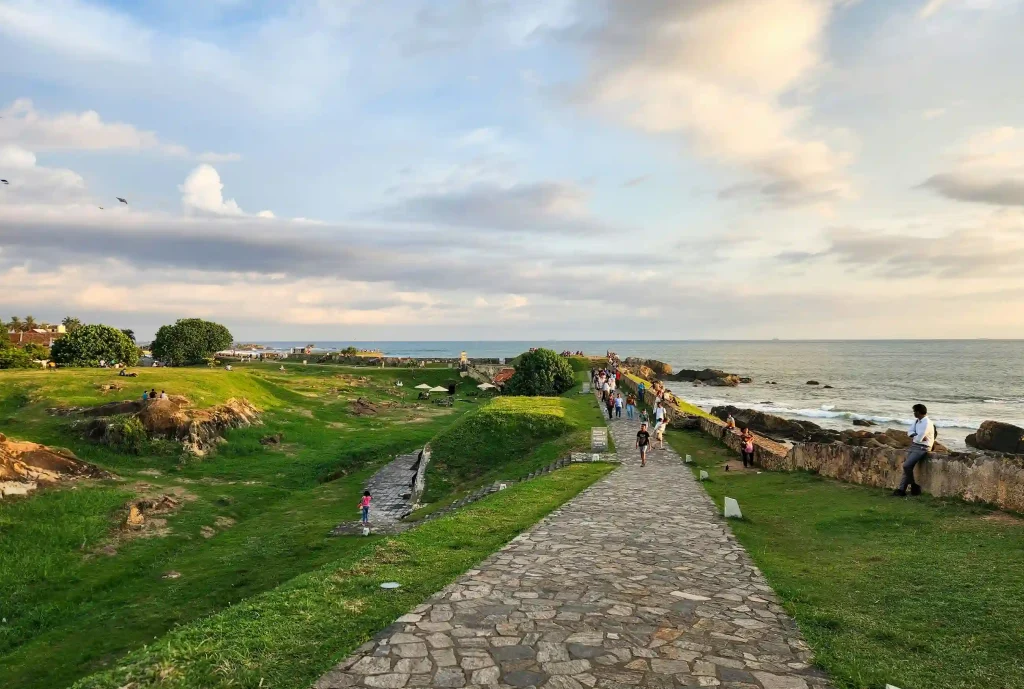
Why the Ramparts Matter
The ramparts are much more than a scenic path around Galle Fort.
They define the historic town physically and help explain why this rocky coastal headland became such an important fortified port.
From the walls, you can look outward towards the Indian Ocean and harbour while also looking inward across tiled roofs, churches, courtyards, streets and residential buildings.
That contrast is one of the easiest ways to understand Galle: military fortifications surround a town that continues to function inside them.
The walls therefore reveal both sides of the World Heritage Site — the defensive system and the living urban settlement it protected.
Why Galle Fort Is a UNESCO World Heritage Site
The Old Town of Galle and its Fortifications was inscribed on the UNESCO World Heritage List in 1988.
Its importance is not based simply on having old European buildings.
Galle represents an unusual combination of European fortification and town-planning ideas adapted to Sri Lankan geography, climate, materials and everyday life.
The ramparts are one of the clearest places to see that adaptation.
Rather than forcing a perfectly symmetrical European fortress onto the site, the walls respond to the shape of the rocky promontory itself.
Portuguese, Dutch and British Layers
Galle’s fortifications developed over several colonial periods.
The Portuguese established the early fortified settlement during the 16th century.
After capturing Galle in the 17th century, the Dutch substantially strengthened and expanded the defensive system into much of the form recognised today.
British administration later adapted parts of the Fort for its own military, civic and administrative requirements while retaining much of the earlier defensive structure.
This is why the Fort should not be understood as belonging neatly to one single colonial period.
What Is a Rampart?
A rampart is the main defensive wall or raised earth-and-masonry structure surrounding a fortified place.
At Galle, the ramparts create a continuous defensive boundary between the old town and the surrounding land and sea.
Their height and thickness allowed defenders to move along the walls, observe approaching threats and position artillery above the surrounding terrain.
Today, those same elevated positions provide some of the best views across Galle and the Indian Ocean.
What Is a Bastion?
A bastion is a projecting section of a fortified wall designed to improve defence.
A straight wall creates areas immediately beside it that defenders may struggle to observe effectively.
By projecting outward, bastions created overlapping fields of vision and allowed defenders to protect adjoining sections of wall.
Once you understand this, Galle’s bastions become much easier to interpret.
Instead of seeing them simply as large viewpoints, notice how each projection relates to the walls on either side.
Landward and Seaward Defences
The Fort faced different defensive challenges depending on direction.
The landward side needed to defend the fortified town against attack approaching from inland.
The seaward side had a different relationship with the natural coastline, harbour and exposed rock.
This difference helps explain why the Fort changes character as you move around its perimeter.
Some sections feel heavily engineered and monumental, while others appear almost integrated into the rocky coast beneath them.
Why the Walls Are Not Perfectly Geometric
One of the most interesting features of Galle Fort is that its walls do not form a perfectly regular European fortress plan.
The engineers adapted the fortifications to the existing rocky headland.
Natural outcrops, changes in coastline and the shape of the promontory influenced where walls and bastions were placed.
This adaptation is part of Galle’s World Heritage significance because it demonstrates how European military engineering was modified for South Asian geography.
Look down occasionally at the rock beneath the walls — the landscape and fortification were designed to work together.
Coral and Granite in the Ramparts
Galle’s fortifications use both coral and granite.
The choice of locally available materials is another example of European construction ideas being adapted to Sri Lankan conditions.
Rather than viewing the walls only from a distance, look carefully at changes in stone texture, masonry and repaired sections.
Centuries of weather, military use, conservation and exposure to salt air have all contributed to the appearance of the walls today.
Moon Bastion
Moon Bastion is one of the major defensive points on the landward side of the Fort.
Its substantial scale gives a strong impression of how seriously the inland approach was defended.
The area also provides broad views beyond the historic town towards modern Galle.
Rather than concentrating only on photographs, look at the relationship between the bastion, adjoining walls and approaches outside the Fort.
This is one of the easiest places to understand the defensive logic of the landward fortifications.
Star Bastion and the Landward Fortifications
Star Bastion forms another important part of the Fort’s landward defensive system.
Together with neighbouring sections of rampart, it demonstrates how multiple fortified positions worked collectively rather than independently.
The views from this side are also useful because they contrast strongly with the open ocean scenery found farther around the walls.
Here, the relationship between the historic Fort and the modern city outside becomes much clearer.
Flag Rock
Flag Rock is one of the most exposed and recognisable sections of Galle’s seaward fortifications.
Its position above the Indian Ocean creates broad views along the coast and across the southern edge of the Fort.
Historically, this coastline had an important relationship with maritime observation and signalling.
Today, the area is especially popular in the later part of the day.
Point Utrecht Bastion
Point Utrecht occupies another important position on the southern seaward edge.
It is closely associated with the lighthouse area but should also be understood as part of the Fort’s defensive system in its own right.
The bastion illustrates particularly well how military structures follow the rocky coastline rather than creating an artificial straight boundary.
The separate Walk Sri Lanka guide to Galle Lighthouse and Point Utrecht goes deeper into the lighthouse, powder magazine and photography around this section.
Other Bastions Around Galle Fort
Galle Fort contains a series of named bastions from different phases of its military development.
You do not need to memorise every name to enjoy or understand the walls.
Instead, use each bastion to notice three things: what direction it faces, which adjoining walls it protects and what part of the surrounding land or sea it overlooks.
This approach makes the military architecture much easier to understand than trying to remember a long list of names and dates.
Gunpowder Magazines and Ammunition Spaces
Fortifications required much more than walls and cannon positions.
Gunpowder and ammunition needed to be stored in protected structures where they could support the defensive system without being unnecessarily exposed.
Several conserved military spaces within Galle Fort now operate as heritage display galleries.
These underground and enclosed structures help explain how the Fort functioned internally rather than showing only its visible exterior walls.
Heritage Galleries Inside the Fortifications
The Galle Heritage Foundation operates interpretive galleries in several restored military spaces.
Displays cover Portuguese, Dutch and British periods and use models, replicated military equipment and historical interpretation to explain the Fort’s development.
The main display galleries currently open from 8:30 am to 5:30 pm daily, including public holidays.
Individual gallery tickets are available at the respective counters.
These galleries are optional additions rather than requirements for understanding the public ramparts.
Why the Inner Town Matters from the Walls
Do not spend the entire walk looking towards the sea.
Turn towards the interior regularly.
From the walls you can see the street grid, tiled roofs, religious buildings, courtyards and historic properties packed within the fortifications.
This is essential to understanding Galle because the walls were built to defend a town, not simply to form an impressive coastal boundary.
The surviving relationship between urban settlement and fortification is one of the strongest features of the World Heritage Site.
Galle Fort Is Still a Living Town
Galle Fort is not an archaeological site from which everyday life has disappeared.
People live, work, worship and attend school inside the walls.
Hotels, guesthouses, restaurants, cafés and shops operate alongside churches, mosques, government buildings and private homes.
This means visitor behaviour matters in ways that are different from an isolated monument.
The Fort’s authenticity depends partly on remaining a functioning urban place rather than becoming only a tourist enclosure.
How Long Should You Allow?
Around two to three hours is comfortable for most visitors who want to understand the ramparts without rushing.
The distance itself is not particularly demanding.
The extra time allows you to stop at bastions, study the architecture, take photographs and look into the streets rather than simply completing the perimeter as quickly as possible.
Travellers mainly interested in a short scenic section can spend less time, while architecture and military-history enthusiasts may want considerably longer.
How Difficult Is the Rampart Walk?
The ramparts are an urban heritage walk rather than a hike.
You do not need specialist trekking equipment or exceptional fitness.
However, the historic surfaces are not completely uniform.
Expect stone steps, uneven sections, changes in level and areas exposed directly to sun and wind.
Comfortable walking shoes are more useful than heavy hiking boots.
Heat on the Ramparts
Much of the Fort wall has very little shade.
During the middle of the day, heat reflected from stone surfaces can make a relatively easy walk considerably more tiring.
Carry drinking water and use sun protection.
If you are sensitive to heat, shorter sections are more comfortable than insisting on completing the full perimeter in one continuous walk.
Walking After Rain
Light rain does not necessarily prevent exploring Galle Fort, but historic stone can become slippery.
Pay additional attention on steps and sloping sections.
Seaward sections can also become more exposed when wind accompanies rain.
Slow down and use the streets below when weather makes an elevated section uncomfortable.
Wind and Rough Coastal Weather
The ocean-facing walls receive the full force of coastal wind.
Strong conditions can make exposed edges feel considerably less secure than they do on a calm day.
Keep away from unprotected drops during rough weather and avoid standing on narrow walls simply for a photograph.
Sea spray and rain can also leave stone unexpectedly slippery.
Safety Around Exposed Edges
Remember that the ramparts were built as military structures centuries before modern visitor-safety standards.
Not every elevated edge has a protective railing.
Do not sit or stand in precarious positions to reproduce photographs seen on social media.
A slightly less dramatic image from secure ground is always the better choice.
Visiting Galle Fort with Children
Children can enjoy the ramparts because there is plenty of open space, ocean scenery and visible architecture.
The main concern is exposed edges.
Keep younger children close around bastions, steps and elevated sections and do not allow them to run freely near drops.
Explaining the bastions as defensive viewpoints can also make the walk more engaging than simply describing each structure by date.
Accessibility
Visitors with reduced mobility can still experience important parts of Galle Fort even if a complete elevated rampart circuit is impractical.
The historic environment contains steps, uneven masonry and changes in level that can make some sections difficult.
Street-level approaches provide access to many views and landmarks without requiring every section of wall to be climbed.
The Galle Heritage Foundation Information Center can also provide current heritage information and guidance on accessible options.
Photography from the Ramparts
The best photographs usually show the relationship between architecture and place rather than isolating one monument.
Use the walls as leading lines towards bastions, rooftops or the ocean.
Looking inward can produce strong photographs of the old street grid, while looking outward reveals the relationship between the fortification and coastline.
Wide-angle lenses are particularly useful for showing the scale of the walls.
Why Quieter Rampart Sections Can Be Better
The most famous viewpoints are not always the strongest places for photography.
Quieter sections often give you more space to study the fortification itself and produce photographs without crowds filling every part of the frame.
Walk a little beyond the busiest gathering points before deciding where to stop.
The structure of the walls changes continuously enough that different sections create very different compositions.
Photography and Local Privacy
When photographing towards the interior, remember that many buildings below are private homes, schools and religious properties.
A high rampart does not turn private courtyards or residents into public photography subjects.
Avoid using long lenses to photograph people inside homes or taking close photographs of children and worshippers without permission.
Normal travel photography and respectful privacy can easily coexist.
Commercial Photography
Ordinary non-commercial visitor photography is permitted without a heritage photography fee.
Commercial photography and filming require authorisation through the relevant Galle Fort heritage authorities.
Professional equipment, organised shoots and commercial content should therefore be planned separately from ordinary sightseeing.
Do You Need a Guide?
No. The public ramparts are straightforward to explore independently.
A knowledgeable heritage guide can add considerable depth if you are particularly interested in military engineering, architecture or the differences between Portuguese, Dutch and British periods.
For independent visitors, understanding the basic functions of a rampart, bastion, magazine and harbour defence system is enough to make the walk much more meaningful.
Is There an Entrance Fee?
There is no general admission ticket for walking the public streets and ramparts of Galle Fort.
You can experience the walls, bastions and public viewpoints freely.
Individual museums, exhibitions and heritage galleries inside the Fort may charge their own admission.
Using the Heritage Information Center
The Galle Heritage Foundation operates a Heritage Information Center for visitors interested in deeper historical context.
The centre provides illustrations, models, audiovisual material, guidebooks and information about Galle Fort.
Guide services can also be arranged through the facility.
It is particularly useful if you want more architectural or military-history background without entering several separate museums.
Why the Ramparts Are More Than a Sunset Spot
The ocean views are beautiful, but reducing the walls to a sunset location misses most of their significance.
The ramparts demonstrate how military engineering, natural geology, harbour geography and urban planning were combined in one fortified settlement.
They also provide a physical boundary around a town that remains inhabited centuries after its military role declined.
Understanding those connections turns an attractive coastal walk into one of Sri Lanka’s most interesting urban heritage experiences.
Responsible Walking in a World Heritage Site
Do not climb unstable walls, damage masonry or remove pieces of stone.
Use rubbish bins where available and carry waste with you when they are not.
Keep entrances, narrow streets and residential access clear.
Respect religious buildings, schools and private homes throughout the Fort.
The strongest way to protect Galle’s heritage is to remember that preservation applies both to the historic structures and to the living community inside them.
Are the Galle Fort Ramparts Worth Walking?
Yes. Walking the ramparts remains one of the clearest ways to understand Galle Fort physically.
The walls reveal the relationship between town and ocean, the function of the bastions, the adaptation of European engineering to a Sri Lankan rocky headland and the continuing life inside the fortified settlement.
You do not need detailed military knowledge to appreciate them.
Simply understanding why the walls project, curve and change with the coastline makes the entire Fort easier to read.