
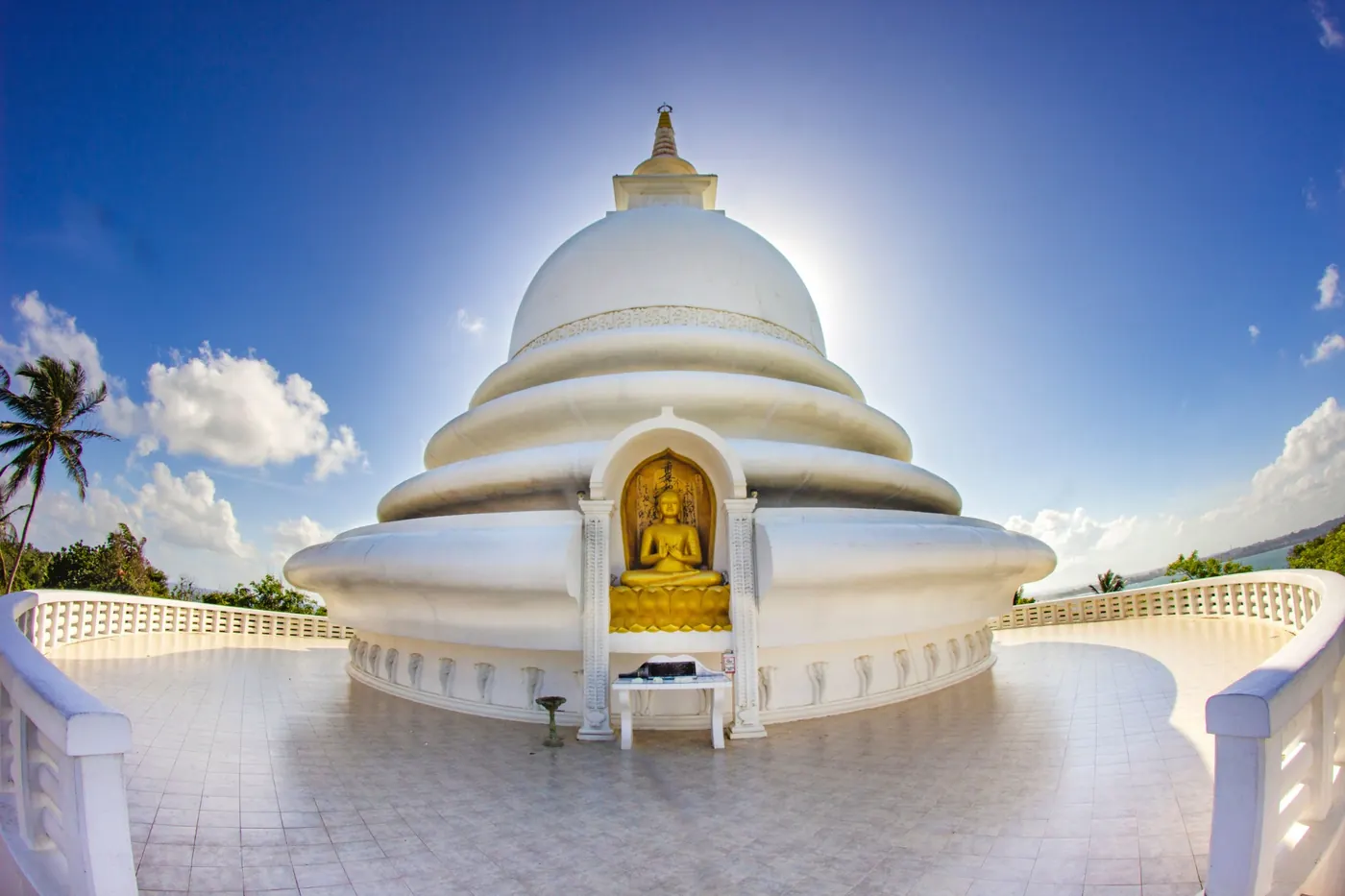
Perched above the southern coastline on Rumassala Hill, the Japanese Peace Pagoda is one of Unawatuna’s most peaceful and recognisable landmarks.
Built in 2005 by Japanese Buddhist monks, the striking white stupa symbolises peace, compassion and non-violence. Surrounded by tropical greenery, it offers sweeping views across Galle Harbour, the Indian Ocean and Sri Lanka’s beautiful southern coast.
For travellers exploring Unawatuna, the pagoda provides a rewarding cultural experience that can easily be combined with nearby Jungle Beach and the natural landscapes of Rumassala.
Explore our Unawatuna Destination Guide for more information about the surrounding area.
Location: Rumassala Hill, Unawatuna, near Galle
Best for: Buddhist culture, coastal views and photography
Time needed: Approximately 45–90 minutes
Best time to visit: Early morning or late afternoon
Entrance fee: Free; voluntary donations welcome
Getting there: Tuk-tuk, private vehicle or uphill walk
Dress code: Modest clothing covering shoulders and knees
Peaceful white stupa overlooking Galle Harbour
Why Visit the Japanese Peace Pagoda?
The Japanese Peace Pagoda is one of the most distinctive cultural attractions near Unawatuna.
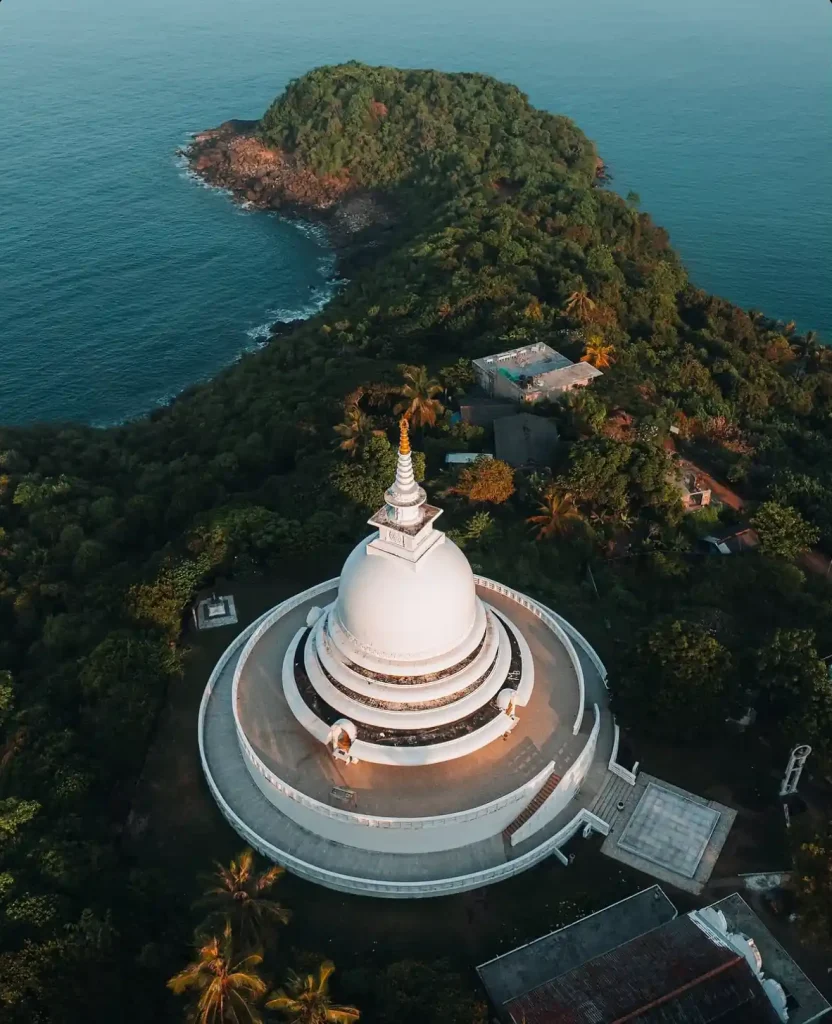
Standing above the forested Rumassala headland, its brilliant white dome contrasts beautifully with the surrounding greenery and deep-blue Indian Ocean.
The peaceful atmosphere makes it an appealing place for reflection, while the elevated position provides some of the finest coastal views in the Galle area.
Unlike many of Sri Lanka’s ancient Buddhist monuments, the Japanese Peace Pagoda belongs to a modern international movement dedicated to promoting peace and understanding.
Visitors can admire its distinctive architecture, observe the golden Buddha statues and appreciate the spiritual significance of the site.
Its convenient location also makes it an excellent addition to a visit to Jungle Beach, Unawatuna Beach or Galle Fort.
The History of the Japanese Peace Pagoda
The Japanese Peace Pagoda at Rumassala was built in 2005 by monks of the Japanese Buddhist order Nipponzan-Myōhōji.
Its construction formed part of an international initiative to establish Buddhist peace monuments across different countries.
The pagoda was completed during Sri Lanka’s civil war, giving its message of peace and non-violence particular significance.
The International Peace Pagoda Movement
The Peace Pagoda movement is closely associated with the Japanese Buddhist monk Nichidatsu Fujii, who founded the Nipponzan-Myōhōji order in 1917.
Fujii believed that Buddhist teachings could encourage peaceful relationships between individuals, communities and nations.
Following the Second World War, the movement developed a tradition of constructing stupas dedicated to world peace.
Peace Pagodas have since been established in countries across Asia, Europe and North America.
The Rumassala pagoda is one of several Peace Pagodas in Sri Lanka, reflecting the cultural and religious connections between Japan and the island.
A Symbol of Peace and Compassion
The pagoda is dedicated to the Buddhist principles of compassion, harmony and non-violence.
Its peaceful hilltop setting encourages visitors to appreciate these ideals through quiet reflection.
Although it is also a popular sightseeing destination, the monument remains an active Buddhist religious site.
Architecture and the Four Golden Buddha Statues
The Japanese Peace Pagoda is immediately recognisable by its elegant white dome, circular terrace and slender spire.
The structure follows the architectural tradition of Japanese Peace Pagodas while incorporating familiar Buddhist stupa symbolism.
Its simplicity is one of its most attractive features, allowing the monument to stand out against the surrounding forest and ocean.
The White Stupa
The central structure consists of a broad white dome rising above a circular base.
Its smooth surfaces and symmetrical design create a calm, balanced appearance.
A decorated spire crowns the dome, while a surrounding walkway allows visitors to appreciate the monument from different angles.
The white colour reinforces the pagoda’s symbolism of purity, harmony and peace.
Four Golden Buddha Statues
Four golden Buddha statues are positioned around the stupa, each housed within a decorative niche.
The images are associated with important events in the Buddha’s life and teachings.
Visitors can walk around the monument to admire these details and appreciate the religious symbolism incorporated into its design.
Japanese inscriptions and decorative elements also reflect the cultural background of the Buddhist order responsible for the pagoda.
The Circular Viewing Terrace
The terrace surrounding the stupa provides attractive views of Rumassala’s forested hillside and the nearby coastline.
Its elevated position creates an impressive contrast between the white monument, tropical vegetation and blue ocean.
The setting is particularly beautiful during the softer light of early morning and late afternoon.
Coastal Views Towards Galle and the Indian Ocean
One of the highlights of visiting the Japanese Peace Pagoda is the spectacular scenery surrounding Rumassala Hill.
The elevated location provides panoramic views across Galle Harbour, with the historic Galle Fort visible in the distance.
Visitors can also admire the Indian Ocean extending beyond the headland, framed by green vegetation and the southern coastline.
Views Towards Galle Fort
From suitable viewpoints around the pagoda, visitors can look towards the historic fortifications of Galle.
The contrast between the modern Buddhist monument and the distant colonial-era city creates an interesting perspective on the region’s cultural landscape.
Clear mornings and late afternoons are particularly attractive for enjoying the scenery.
Landscape Photography
The white pagoda is an excellent subject for photography, particularly when framed against blue skies and tropical greenery.
Wide-angle photographs can capture the monument alongside its coastal surroundings.
For closer compositions, the golden Buddha statues provide beautiful architectural details.
Late-afternoon light creates warmer tones across the structure and surrounding landscape.
Photographs should be taken respectfully without disturbing worshippers or blocking access around the shrine.
Best Time to Visit the Japanese Peace Pagoda
The Japanese Peace Pagoda can be visited throughout the year.
However, the time of day and seasonal weather can influence the experience.
Early Morning
Early morning is particularly attractive for visitors seeking a quieter atmosphere.
Temperatures are generally cooler, and the softer light creates beautiful conditions for photography.
This is an excellent time to appreciate the peaceful surroundings before larger groups arrive.
Late Afternoon and Sunset
Late afternoon is another rewarding time to visit.
The lower sun creates warm light across Rumassala Hill, Galle Harbour and the surrounding coastline.
The elevated position makes the pagoda a popular location for enjoying the changing colours of the evening sky.
Allow sufficient time to explore the monument before daylight fades, particularly if returning on foot.
Best Season
November to April generally brings more favourable weather to Sri Lanka’s southern coastline.
This period is particularly suitable for combining the pagoda with beach visits and outdoor exploration.
During the southwest monsoon, approximately May to September, the region experiences increased rainfall and less settled coastal conditions.
The pagoda remains a worthwhile cultural attraction throughout the year.
Entrance Fees, Opening Hours and Dress Code
The Japanese Peace Pagoda is a welcoming religious landmark that visitors can enjoy without purchasing an admission ticket.
Entrance Fee
Admission is free.
Visitors may make voluntary donations towards the upkeep of the religious site.
There is no standard tourist entrance ticket.
Opening Hours
The pagoda is best visited during daylight hours, particularly in the early morning or late afternoon.
Daytime access is generally available, although arrangements may vary during religious activities and special observances.
What to Wear
As an active Buddhist religious site, the Japanese Peace Pagoda requires respectful clothing.
Visitors should cover their shoulders and knees.
If arriving directly from Unawatuna Beach, carry a sarong or lightweight cover-up rather than visiting in swimwear.
Remove footwear where required around sacred areas and follow instructions displayed at the site.
Respectful Behaviour
Keep conversations quiet, particularly when monks or worshippers are praying.
Do not climb on the stupa, sit against Buddha statues or use sacred structures as props for photographs.
Avoid posing with your back directly towards Buddha images for close-up portraits.
Ask permission before photographing worshippers or religious ceremonies.
These simple practices help preserve the peaceful atmosphere and religious importance of the monument.
How to Get to the Japanese Peace Pagoda
The Japanese Peace Pagoda is located on Rumassala Hill, between Unawatuna and Galle.
Visitors can reach the site by tuk-tuk, private vehicle or established walking routes.
From Unawatuna
A tuk-tuk is the most convenient option for most travellers.
The route follows local roads towards Rumassala, with access available close to the pagoda.
Agree on the fare before departure and arrange return transport if necessary.
Walking from Unawatuna Beach
Visitors who enjoy walking can reach the pagoda from the western end of Unawatuna Beach.
The uphill route generally takes approximately 20 minutes, depending on the starting point and walking pace.
Sections can be steep, particularly in hot weather.
Wear comfortable footwear and carry drinking water.
Walking is most enjoyable during the cooler morning or late-afternoon hours.
From Jungle Beach
The Japanese Peace Pagoda is close to Jungle Beach, making the two attractions convenient to visit together.
Established walking routes connect parts of the Rumassala hillside with the beach.
The paths pass through tropical vegetation and can become slippery after rainfall.
Follow recognised trails and avoid unmarked shortcuts along steep slopes.
From Galle
Travellers staying in Galle can easily arrange a tuk-tuk or private vehicle to reach Rumassala.
The pagoda is only a short road journey from the Galle area.
Visitors can combine the experience with sightseeing around the historic fort or a relaxed afternoon in Unawatuna.
Rumassala Hill and the Ramayana Legend
Rumassala Hill is associated with one of Sri Lanka’s best-known stories from the Ramayana tradition.
According to the legend, Hanuman carried a mountain containing medicinal plants from the Himalayas towards Lanka.
A fragment is believed to have fallen along the southern coastline, forming the hill now known as Rumassala.
This story forms an important part of the area’s cultural and religious identity.
Rumassala is also valued for its forested environment, coastal scenery and biodiversity.
The Japanese Peace Pagoda adds a modern Buddhist landmark to a landscape already rich in cultural associations.
Nearby Attractions Around Rumassala
The Japanese Peace Pagoda is conveniently located near several of Unawatuna’s most popular attractions.
Jungle Beach
Jungle Beach is a small coastal cove surrounded by the forested slopes of Rumassala.
Its sheltered appearance and tropical setting make it a popular choice for visitors seeking a quieter beach experience.
Swimming and snorkelling conditions depend on the weather, currents and sea conditions.
Explore our Jungle Beach Unawatuna Visitor Guide.
Unawatuna Beach
Unawatuna Beach is one of Sri Lanka’s most popular southern coastal destinations.
Its curved sandy bay is lined with restaurants, guesthouses and accommodation, making it a convenient base for exploring the surrounding area.
Visitors can enjoy swimming when conditions are suitable, beachfront dining and relaxed coastal walks.
Read our Unawatuna Beach Swimming and Visitor Guide.
Galle Fort
Located a short journey from Rumassala, Galle Fort is a UNESCO World Heritage Site known for its historic streets, colonial-era architecture and impressive coastal ramparts.
Its cafés, boutique shops and heritage landmarks make it a rewarding destination for a leisurely visit.
Practical Tips for Visiting
Allow approximately 45–90 minutes to enjoy the pagoda, admire its architecture and appreciate the surrounding views.
Travellers walking uphill from Unawatuna or combining the visit with Jungle Beach should allow additional time.
Carry drinking water, sunscreen and a hat, especially during warmer months.
Families with young children and travellers with reduced mobility may find tuk-tuk access more convenient than the hillside walking routes.
The site includes steps and walking areas, so comfortable footwear is recommended.
Respect the religious setting, dispose of rubbish responsibly and avoid disturbing wildlife in the surrounding Rumassala forest.
Is the Japanese Peace Pagoda Worth Visiting?
The Japanese Peace Pagoda is one of Unawatuna’s most rewarding cultural landmarks, combining beautiful Buddhist architecture with spectacular coastal scenery.
Its peaceful atmosphere, fascinating history and convenient location make it an excellent experience for travellers seeking something beyond the beaches of southern Sri Lanka.